

Today, China launched a trade-remedy investigation into imports from the European Union. The case follows an application filed with China’s Ministry of Commerce (MOFCOM) by two major Chinese producers of para-nitrotoluene, which allege that EU companies may be exporting the chemical to China at below normal value, causing injury to domestic producers. MOFCOM determined that the application met the preliminary requirements for initiation and formally opened the investigation on October 3. Para-nitrotoluene is a chemical intermediate mainly used in the production of dyes, pigments, pesticides and pharmaceuticals. Importantly, no final anti-dumping duties have been imposed at this stage. This is only the opening of an investigation, and China has not yet determined that the EU is dumping the product.
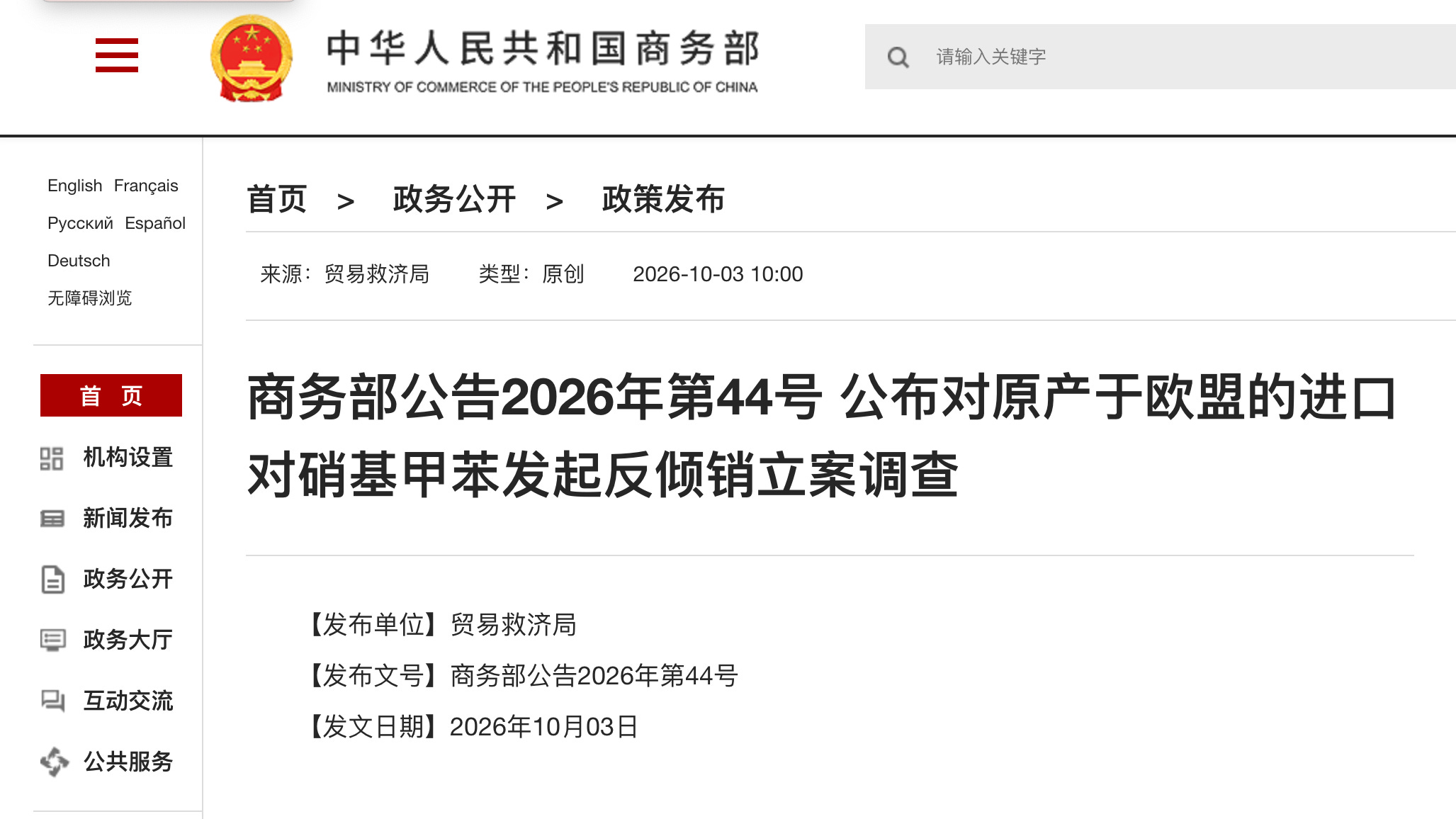
MOFCOM will now examine two central questions: whether EU products are in fact being dumped at unfairly low prices, and whether those imports are causing material injury to the Chinese industry. EU producers and exporters, as well as Chinese importers, may participate in the investigation and submit evidence. The investigation would normally be completed within one year, although it may be extended by six months in special circumstances. If MOFCOM ultimately determines that dumping occurred, that the domestic industry suffered injury, and that there is a causal link between the two, China could impose additional anti-dumping duties on the relevant EU products. If the evidence is insufficient, the investigation could be terminated without measures.
The product under investigation is para-nitrotoluene (PNT), also known as 4-nitrotoluene, a specific type of nitrotoluene. It normally appears as pale-yellow crystals and can essentially be understood as an intermediate chemical feedstock that undergoes further processing before reaching end products. Product information published by both LANXESS and Indian producer Aarti lists this substance.
PNT is mainly used in production chains for dyes, pigments and certain pesticide and pharmaceutical intermediates. For example, it can be further processed into p-toluidine, p-nitrobenzoic acid and DSD acid. DSD acid is in turn used to manufacture optical brighteners, which ultimately find applications in paper, textiles, detergents and other products. Its connection to everyday consumer goods therefore generally involves several stages of downstream processing.
According to the application published by MOFCOM, China imported 6,565 tonnes of PNT from the EU in 2025, worth approximately US$3.66 million and accounting for 7.14% of Chinese demand for the product. Imports stood at 9,817 tonnes in 2024. In other words, based on the figures provided in the application, import volumes actually fell by roughly one-third in 2025.
These figures also suggest that China already has substantial alternative sources of supply. With annual EU imports worth only around US$3.66 million, the direct trade value involved in this individual case is relatively limited. Its impact is therefore likely to be more significant for the specific product lines and companies concerned than for the European chemical industry as a whole.
In an anti-dumping application concerning the same type of product filed in India in 2025, Indian producer Aarti identified Germany’s LANXESS as the EU’s largest producer, with annual capacity of approximately 35,000 tonnes. The application described China and India as major markets for LANXESS and claimed that exports accounted for roughly 70% of its production capacity.
The Chinese application specifically identifies LANXESS Deutschland GmbH as a producer and LANXESS Chemical (China) Co., Ltd. as a known importer. If duties are eventually imposed, LANXESS could face two forms of pressure on this business: raising its prices in China and potentially losing some orders, or absorbing part of the additional cost in order to retain customers. Even during the investigation, the company is likely to face additional legal and compliance costs as well as greater uncertainty over contract pricing.
On the Chinese side, the most direct potential beneficiaries are the two applicants, Jiangsu Huaihe Chemical Co., Ltd. and Hubei Dongfang Chemical Co., Ltd. The application also identifies four other Chinese producers of the same product: Jiangsu Foster Chemical Manufacturing Co., Ltd., Shandong Dyck Biotech Dongao Chemical Co., Ltd., Shandong Shenxian Yingtai Chemical Co., Ltd., and Shandong Yingxin Chemical Co., Ltd.
The first potential benefit for these producers would be reduced downward price pressure from allegedly low-priced imports; import substitution and higher sales could follow. The actual effect would depend on the final measures, available domestic production capacity, product quality and how quickly customers can switch suppliers. Chinese downstream producers of dyes, optical brighteners and other products, however, could face higher input costs. The effects on Chinese chemical companies are therefore not uniform: producers of PNT may benefit, while companies that purchase it may face higher costs. Third-country suppliers such as India’s Aarti could also potentially capture additional orders, since the investigation is defined by EU origin.
Why has China chosen this particular chemical for an anti-dumping investigation? The most immediate explanation is that there was a formal petition from the domestic industry. According to MOFCOM, preliminary evidence submitted by the applicants showed that the price of EU PNT imports fell by nearly 60% between 2022 and 2025, and the applicants argued that the domestic industry suffered injury as a result.
Second, the case also appears to carry a policy signal in response to EU trade-remedy actions against Chinese chemical products, and this interpretation is supported by MOFCOM’s own public comments. In explaining the case, MOFCOM specifically noted that the EU has initiated 28 trade-remedy investigations against China since 2025, around half of them involving chemical products, including three recent investigations covering products such as polyvinyl chloride. By explicitly discussing the PNT case alongside EU chemical investigations, MOFCOM appears to be signalling that it wants Brussels to consider the interests of industries on both sides.
Q: We note that MOFCOM today launched an anti-dumping investigation into imports of para-nitrotoluene originating in the EU. Could you provide more information?
A: The investigation was initiated following an application from the domestic industry. Preliminary evidence submitted by the applicants indicates that between 2022 and 2025, imports of para-nitrotoluene from the EU remained at high levels, while their prices fell by nearly 60% cumulatively, and that dumped imports from the EU caused injury to the production and operations of the Chinese domestic industry. Under Chinese law and WTO rules, the application met the requirements for initiating an anti-dumping investigation. China will conduct the investigation in accordance with laws and regulations, fully safeguard the rights of all interested parties, and reach an objective and impartial determination.
It should be emphasized that China has consistently maintained a prudent and restrained approach to trade remedies. At the same time, since 2025, the EU has initiated 28 trade-remedy investigations against China, approximately 50% of which involve chemical products. In particular, it has recently launched three consecutive investigations involving Chinese chemical products, including polyvinyl chloride. China has repeatedly stressed that the EU should face up to the economic and trade issues it confronts and resolve the concerns of both sides through dialogue and consultation.
From an industry-structure perspective, China has domestic alternative suppliers of nitrotoluene, meaning that restrictions on EU imports would not necessarily create a serious shortage. At the same time, European producers would need to find alternative outlets for their output, making trade measures relatively easy to transmit into individual companies’ commercial decisions. Another production characteristic is also worth noting: according to industry application materials, ortho-, meta- and para-nitrotoluene are typically produced together. This suggests that if one of these products becomes difficult to sell, a producer may not be able simply to stop producing that single product; inventories and the economics of the entire production facility could be affected.
Meanwhile, China-EU trade negotiations are continuing, but there is no indication yet that the two sides have reached a new substantive agreement. The immediate focus is preparation for talks in Beijing on October 8–9, when EU Trade Commissioner Maroš Šefčovič is expected to meet Chinese Commerce Minister Wang Wentao. The European side is looking for concrete outcomes that can demonstrate that continued negotiations are producing results.
Preparatory discussions have already taken place. On September 23–24, negotiating teams from the two sides held two days of consultations in Beijing. China’s Ministry of Commerce confirmed the talks but did not disclose any substantive agreements.
The EU’s concerns centre on three issues: the rapid growth of Chinese goods entering the European market, continuing barriers facing European goods in China, and whether European companies can obtain reliable access to Chinese supplies of rare earths and other critical materials. The European side wants China to restrain export growth in certain product categories, increase purchases of European goods, improve market access, and make export licensing more predictable.
Automobiles and chemicals are among the most sensitive areas in the negotiations. According to the Financial Times, the EU has asked China to limit exports of hybrid vehicles to Europe. Euronews has also reported discussions of possible quotas for certain products and the potential suspension or postponement of some chemical trade measures.
This week, the European side has become increasingly urgent about securing tangible results. On October 1, European Commission officials said that industries including machinery, textiles, basic metals and chemicals continued to face pressure from rising imports, with China being a major driver of that increase. The European view is that if negotiations continue without producing concrete outcomes, internal pressure within Europe for additional trade restrictions is likely to intensify.