

On January 7, China’s Ministry of Commerce initiated an anti-dumping investigation into dichlorosilane originating from Japan.
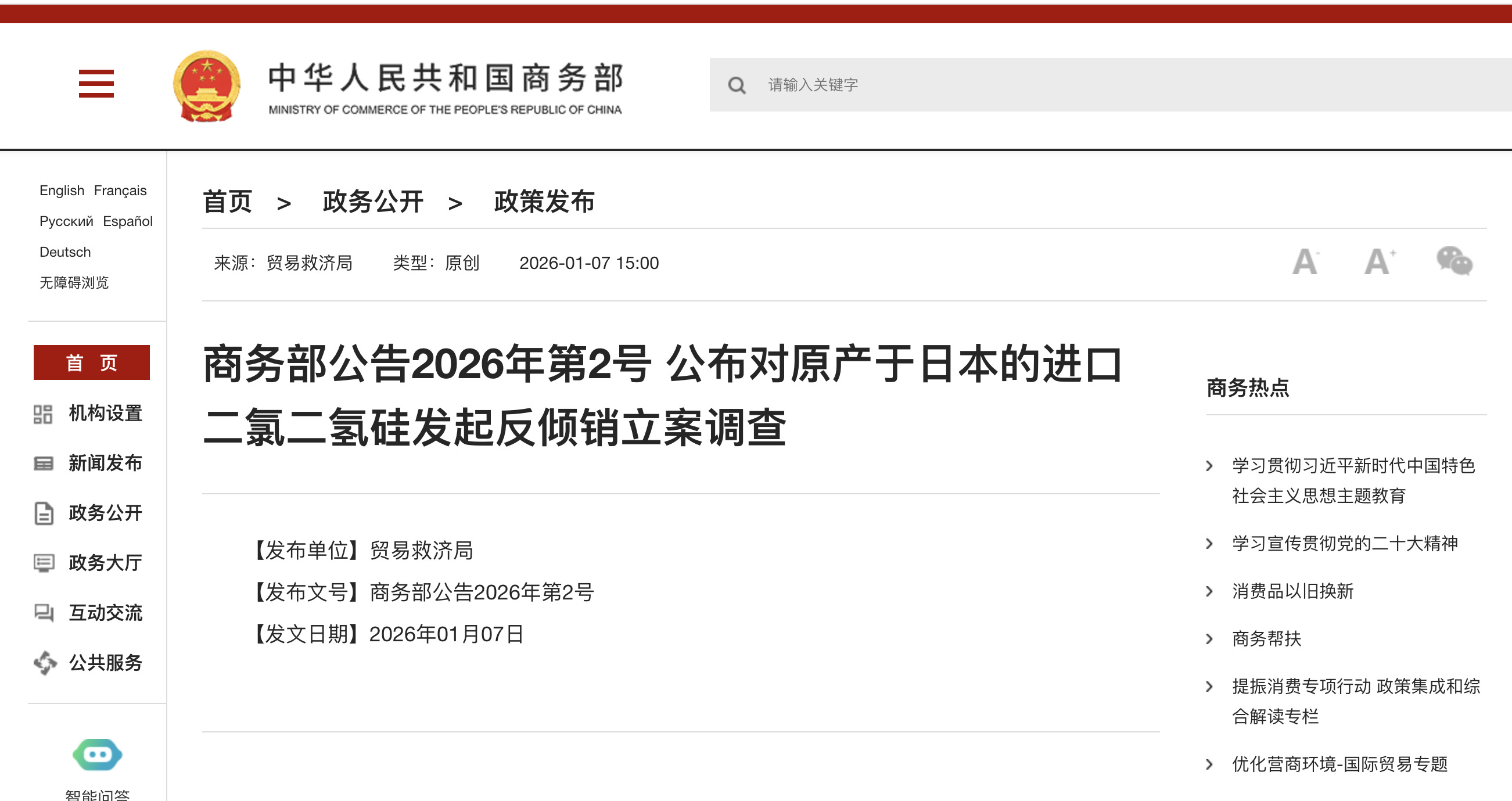
According to the official announcement by MOFCOM, the investigation was launched on the basis of evidence submitted by a Chinese company, Tangshan Sunfar New Materials Co.,Ltd. and in accordance with the relevant provisions of the Anti-Dumping Regulations of the People’s Republic of China.
Tangshan Sanfar Electronic Materials Co., Ltd.(Sanfar) is a Chinese manufacturer of chemical and electronic materials and a supplier of raw materials in the electronic chemicals category. The company has production and R&D capabilities in electronic chemicals such as dichlorosilane (DCS) and is one of the important enterprises in China’s relevant chemical raw materials industry.
Dichlorosilane is a precursor chemical mainly used in thin-film deposition processes in chip manufacturing (such as epitaxial films, silicon nitride films, and silicon oxide films) and is of significant importance to integrated circuit manufacturing.
In its petition, Sunfar alleges that Japanese producers of dichlorosilane (such as Shin-Etsu Chemical and Air Liquide Japan), in order to maintain their market share in China and suppress the development of China’s domestic industry, adopted low-price dumping strategies. Dichlorosilane produced by these Japanese companies accounted, on average, for nearly 81% of China’s total imports of like products between 2022 and 2024, giving them a long-standing dominant position and allowing them to exert decisive influence over price trends in the Chinese market.
Their export prices declined continuously from 323 yuan per kilogram in 2022 to 223 yuan per kilogram in 2024, representing a cumulative decrease of nearly 31%. These prices were below the production costs of comparable domestic Chinese products, with dumping margins exceeding 90%. Under the dual impact of a sharp increase in import volumes and a significant drop in prices, Chinese domestic producers were forced to follow suit and cut prices, resulting in a severe mismatch between prices and costs. This led to sustained and substantial losses, underutilized production capacity, large inventory backlogs, and negative effects on employment and wages. As a result, China’s domestic dichlorosilane industry suffered material injury.
Sunfar argues that, under these circumstances, the timely and effective initiation of an anti-dumping investigation and the adoption of corresponding anti-dumping measures would help restore a distorted market competition order, protect the legitimate rights and interests of the domestic dichlorosilane industry, and safeguard its normal development. At the same time, conducting an anti-dumping investigation into dichlorosilane and imposing anti-dumping measures would not materially affect the normal production and operations of downstream industries; on the contrary, it would be conducive to their stable and orderly development. Therefore, initiating an anti-dumping investigation into dichlorosilane imported from Japan and adopting anti-dumping measures is consistent with China’s public interest.
If the investigation finds that dumping has occurred and has caused injury to China’s domestic industry, MOFCOM may impose anti-dumping duties on dichlorosilane imported from Japan. The duty rates are typically linked to the “dumping margin” and are intended to offset the price differences caused by dumping.
Japanese exporters of dichlorosilane subject to anti-dumping duties would face the following consequences:
Higher prices: The tax burden would be added to product prices, increasing their selling prices in the Chinese market.
Reduced competitiveness: Comparable domestic products (such as Sanfu’s own products) would gain a price advantage.
Shrinking market share: Over the long term, weakened price competitiveness would affect the market share of Japanese exporters.
If Japan believes that the investigation or the measures taken are inconsistent with WTO rules, it may request dispute settlement proceedings at the WTO. There are precedents for this in past China–Japan trade frictions, such as WTO disputes involving steel products.
Japanese companies (such as Shin-Etsu, Taiyo Nippon Sanso, and Sumitomo Seika) are major producers in the global electronic-grade dichlorosilane market, together accounting for approximately 74.49% of global sales (including Japanese and other overseas companies). China is a major consumer of dichlorosilane and also the largest export market for Japanese dichlorosilane.
Notably, in late November last year, there were reports that Japan was considering completely suspending shipments of photoresists to China since mid-November. Although neither the Japanese government nor the companies involved have made an official announcement, industry insiders in both Japan and China reportedly regard this as a settled matter.
When I saw this report, I immediately thought that if China were to impose controls on rare earths exported to Japan, Japan might in turn ban exports of photoresists to China. However, in addition to sourcing photoresists from Japan, China can also purchase them from South Korea. In 2019, Japan briefly imposed export controls on photoresists to South Korea. Since then, the South Korean government and companies have significantly stepped up efforts to localize semiconductor materials. South Korea is now capable of producing photoresists and has developed solid capabilities in KrF and ArF photoresists for mature and semi-advanced process nodes.
Although Japan remains the irreplaceable global leader in the most advanced photoresists, such as EUV photoresists, China is currently still focused mainly on R&D and the introduction of mid- to low-end products. The shortfall in China’s domestic supply can, in fact, be fully substituted with South Korean products.
What is particularly noteworthy is that South Korean President Lee Jae-myung is paying a four-day state visit to China, during which both sides are determined to build more concrete outcomes of cooperation in emerging fields such as artificial intelligence. Lee stated that the comprehensive restoration of China–South Korea relations is one of the most significant diplomatic achievements of his administration and a source of great pride.
The most prominent highlight of this visit is undoubtedly the unprecedentedly large South Korean business delegation. This marks the first time in six years that South Korea has organized a delegation of business leaders to accompany the president on a visit to China, and the number of participants has doubled compared with six years ago. The heads of Samsung, SK, LG, and Hyundai—the country’s four largest conglomerates—all took part, along with leading figures from the semiconductor, new energy, and automotive sectors.
During Lee’s visit, semiconductor cooperation is likely to be one of the core topics. Both China and South Korea hope to achieve breakthroughs in supply chain stability, technological upgrading, and market expansion. South Korea has strengths in semiconductor chip manufacturing and advanced battery technologies, but the core raw materials that underpin these advantages remain highly dependent on China. For South Korea’s semiconductor giants, China is not only a source of raw materials, but also their largest market and the most reliable supply chain backbone. China has also pledged to provide South Korea with adequate assurances regarding rare earth exports.
At this sensitive moment, China’s decision to take proactive action against Japan in the field of semiconductor materials may also serve as a warning to Japan: if it were to impose export controls on photoresists, the parties that would ultimately suffer the greatest losses would be Japanese companies themselves. After all, China’s demand is difficult to replace, and photoresists are materials with a limited shelf life that cannot be stored for extended periods.
According to Bloomberg, when asked about China’s new controls, Lee Jae-myung struck a cautious tone as he sought to avoid being dragged into a conflict between South Korea’s two key neighbours.
“If we intervene at the wrong time, it may not be helpful. When the time and circumstances are right, we will look for an appropriate role to play,” Lee said, adding that what Seoul can do at this point is “very limited.”
Yesterday, China imposed an export ban on dual-use items to Japan, and there were also reports that China is considering restricting rare earth exports to Japan. Today, a spokesperson for China’s Ministry of Foreign Affairs responded to questions from the media on this matter:
NHK reporter: Yesterday, China’s Ministry of Commerce released an announcement on strengthening export controls on dual-use items to Japan. China’s officially published 2026 Catalogue for the Administration of Export Licenses for Dual-Use Items and Technologies includes items related to rare earths. Do the enhanced export control measures on Japan announced yesterday also cover rare earth products? Last night, the Japanese government lodged a protest with China, citing that China’s measures against Japan deviate from international practice, and demanded that they be withdrawn. What is China’s comment on this?
Mao Ning: For specific issues, please consult the relevant Chinese authorities. I would like to point out that Japanese Prime Minister Sanae Takaichi’s erroneous remarks regarding Taiwan infringe upon China’s sovereignty and territorial integrity, constitute a blatant interference in China’s internal affairs, and amount to a threat of the use of force against China. In order to safeguard national security and interests and to fulfill international obligations such as non-proliferation, China has taken measures in accordance with laws and regulations. These measures are fully justified, reasonable, and lawful. We urge the Japanese side to face up to the root causes of the issue, reflect on and correct its mistakes, and withdraw Prime Minister Sanae Takaichi’s erroneous remarks.
Today, Japan’s Chief Cabinet Secretary Kihara also responded at a press conference to China’s move to strengthen export controls on dual-use items, stating that the Japanese government has taken note of the situation, is currently assessing its impact on Japanese industries, and will later study and formulate the necessary response measures.
Reporter: I am a reporter from Kyodo News. I would like to ask about China’s export controls on civilian-related products. The Chinese government has announced that it will strengthen export control measures on certain civilian products to Japan. Some observers believe this is a countermeasure in response to remarks made by the Japanese prime minister in the Diet regarding a Taiwan contingency. How does the Japanese government view what it sees as economic pressure exerted by China through these measures? What is the government’s current assessment of the impact of these measures on Japanese companies and industries? In addition, what countermeasures does Japan plan to take going forward? If the Japanese government has information on whether the controlled items include rare earth-related products, please also let us know.
Chief Cabinet Secretary Kizon: We are aware of the Chinese government’s announcement yesterday regarding the strengthening of export controls on dual-use items to Japan. Such unilateral control measures targeted specifically at Japan seriously violate the fundamental principles of international trade, and Japan cannot accept them and will not recognize them. Japan’s Ministry of Foreign Affairs, the Ministry of Economy, Trade and Industry, and the Japanese Embassy in China have lodged strong representations with the Chinese side, issuing a firm protest and demanding that the measures be withdrawn. At present, there remain many unclear points, including the specific scope of items covered by the controls, and therefore it is premature to comment on the impact on Japanese industries. After conducting a careful review and analysis of the relevant details, Japan will consider and take necessary response measures.
Reporter: I am Takeuchi from Asahi Shimbun. This question overlaps somewhat with the previous one. Regarding whether the controlled items include rare earths, the information is still unclear, so the government is currently unable to make a determination—is that understanding correct?
Chief Cabinet Secretary Kizon: As I mentioned earlier, the objects and specific contents of these control measures are still unclear at this stage. Precisely because the situation has not yet been clarified, further verification and analysis are required to determine which industries may be affected and in what way. Once the relevant policy analysis is completed, we will then examine and formulate the necessary response measures.