

On August 10, China’s Ministry of Commerce (MOFCOM) issued Announcement No. 32 of 2026, publishing its preliminary determination in the anti-dumping investigation into pecans imported from Mexico and the United States. MOFCOM preliminarily determined that imports of the products under investigation from both countries were being dumped, that China’s domestic pecan industry had suffered material injury, and that there was a causal link between the dumping and the injury.
Pursuant to Articles 28 and 29 of China’s Anti-Dumping Regulations, MOFCOM decided to impose provisional anti-dumping measures in the form of cash deposits. Beginning August 11, 2026, importers of the products under investigation are required to provide deposits to Chinese Customs based on the deposit rates assigned to the relevant companies in the preliminary determination.
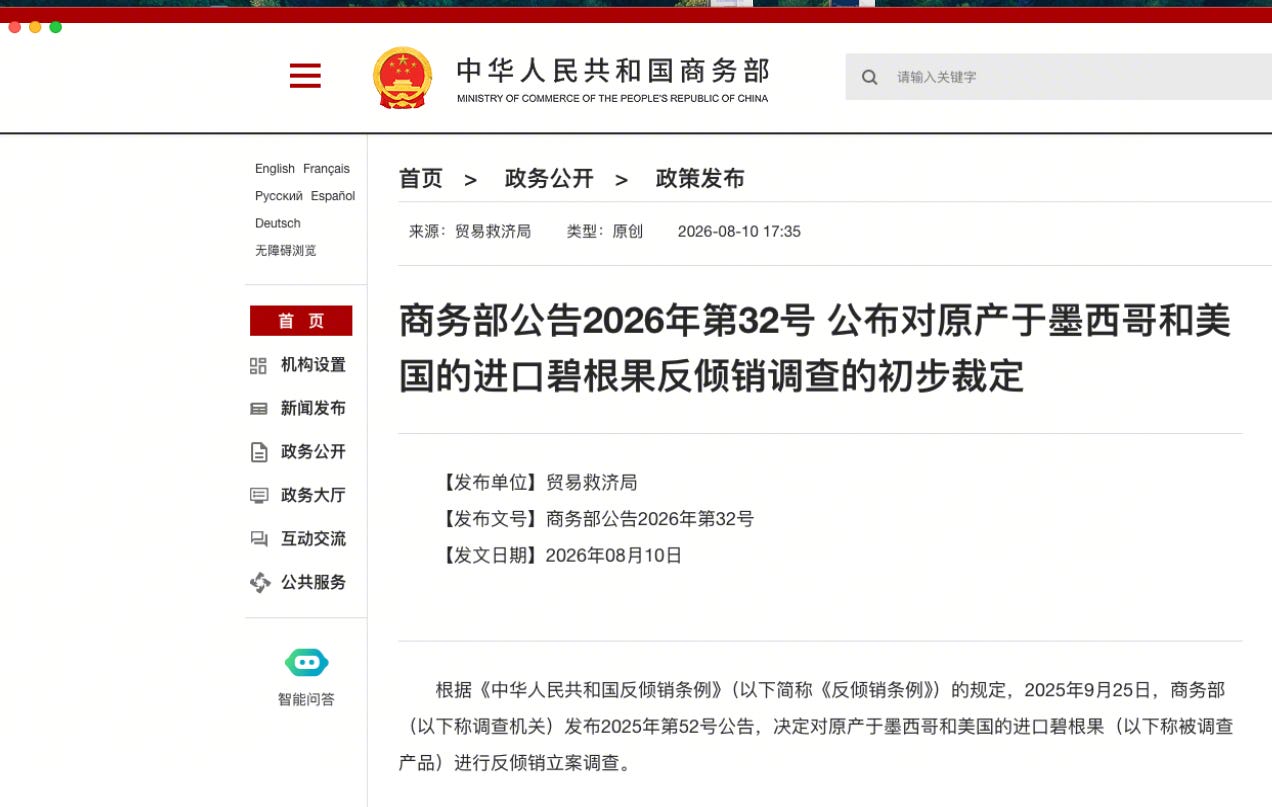
Notably, the case was initiated by MOFCOM on its own initiative rather than in response to a written petition from Chinese domestic producers. MOFCOM relied on the “special circumstances” provision under Article 18 of the Anti-Dumping Regulations. Its explanation was that China’s domestic pecan-growing industry is highly fragmented, has a low level of concentration, and involves a large number of growers, making it costly and difficult for the industry to organize and file an anti-dumping petition itself. The investigating authority therefore initiated the case on its own initiative. The dumping investigation period covered the full year of 2024, while the injury investigation period extended from 2022 through 2024. Separately, on September 25, 2025, China also launched a trade and investment barrier investigation into Mexico’s restrictive measures targeting China.
Following the outbreak of U.S.-China trade tensions in 2018, U.S. pecan exports to China were hit hard by retaliatory tariffs and fell sharply from their peak around 2017. In recent years, the U.S. pecan industry has been hoping to regain access to the Chinese market, while Mexico has emerged as an important source of incremental supply. China’s decision to investigate both countries at the same time therefore carries a clear message that circumvention will not be tolerated: it restricts direct U.S. exports while also putting pressure on Mexico and discouraging attempts to route U.S. products through Mexican processing and supply chains.
There is also a domestic industrial-policy rationale. China’s pecan-growing industry remains in the early stages of scaling up. Competition from low-priced imports does not merely put direct downward pressure on domestic prices; it may also discourage new planting and reduce growers’ incentives to make subsequent investments in orchard management. This is an important part of the industry-protection rationale disclosed by MOFCOM.
One particularly noteworthy detail concerns MOFCOM’s injury analysis. The investigating authority did not use the aggregated data submitted by the six sampled domestic producers. Instead, it relied on nationwide industry statistics provided by the Research Institute of Non-Timber Forestry under the Chinese Academy of Forestry. MOFCOM explained that the questionnaire responses from the sampled companies contained missing and inconsistent data and therefore could not reasonably reflect the overall condition of the domestic industry. This suggests that the statistical system for China’s pecan industry remains relatively underdeveloped, and the investigating authority’s methodology could consequently face questions over procedural compliance.
No U.S. producer or trader registered to participate in the investigation within the prescribed period. The U.S. Embassy in China registered as an interested party, but no U.S. company participated at the corporate level. As a result, all U.S. companies are subject to a uniform 54.3% cash deposit rate, with no differentiation among companies and no company-specific exceptions. This is the highest rate imposed in the preliminary determination. Once combined with existing tariffs and value-added tax, the resulting import cost will leave Chinese importers with very little economic incentive to continue purchasing U.S. pecans.
A further consequence is that U.S. companies lost the procedural opportunity to seek lower company-specific rates at the preliminary stage. If U.S. companies participate in the investigation during the subsequent final-determination stage, they could in theory seek review or differentiated rates. However, the across-the-board rate imposed at the preliminary stage has already caused a de facto disruption of trade, and the commercial losses during this interim period are real.
The situation for Mexico is more complicated because Mexican companies participated in the investigation and therefore received differentiated deposit rates. The two sampled companies—San Enrique Agricultural Enterprises and Alta Vineyards—are subject to rates of 23.0% and 17.8%, respectively. Four other cooperating Mexican companies are subject to a 22.2% rate, while other non-cooperating Mexican companies face a 51.6% rate, broadly comparable to the rate imposed on U.S. companies.
From an industry-incentive perspective, the leading and cooperating Mexican companies secured significantly more favorable treatment by participating in the investigation and therefore retain some possibility of preserving their Chinese orders. Nevertheless, even a 17.8% deposit represents a substantial additional cost and is likely to prompt Chinese importers to put pressure on Mexican suppliers during price negotiations to share part of that burden. For non-cooperating Mexican companies, the 51.6% rate effectively amounts to being priced out of the Chinese market.
Mexico’s pecan industry is sizable. Industry estimates put its 2024 production at approximately 129,000 metric tons, broadly comparable to U.S. production. These figures should not be treated as precise customs statistics, as estimates vary depending on whether they are measured on an in-shell or kernel basis and on differences in crop-year definitions. The industry estimate cited here comes from Mundus Agri. Mexico’s pecan industry has traditionally been deeply integrated with U.S. processing and consumer markets, while China has become an important source of incremental demand in recent years. If Chinese orders contract, Mexican growers could simultaneously face greater competition in the U.S. market and fluctuations in domestic production, with pressure transmitting upstream from exporters to growers and harvesting operations.
Overall, China’s approach toward the United States looks more like closing the door, while its approach toward Mexico is more akin to screening: cooperating companies are allowed to retain some market access, while non-cooperating companies are effectively pushed out.
At the same time, the measure sends a broader signal to the Mexican government: if Mexico unilaterally absorbs the costs of restrictions targeting China as U.S.-China supply chains are reconfigured, Beijing has trade-policy tools with which to respond.
Full translation of the announcement:
MOFCOM Announcement No. 32 of 2026
Preliminary Determination in the Anti-Dumping Investigation into Imports of Pecans Originating in Mexico and the United States
Issuing Department: Trade Remedy and Investigation Bureau
Document No.: MOFCOM Announcement No. 32 of 2026
Date of Issuance: August 10, 2026
In accordance with the provisions of the Anti-Dumping Regulations of the People’s Republic of China (the “Anti-Dumping Regulations”), on September 25, 2025, the Ministry of Commerce of the People’s Republic of China (“MOFCOM” or the “Investigating Authority”) issued Announcement No. 52 of 2025, deciding to initiate an anti-dumping investigation into imports of pecans originating in Mexico and the United States (the “product under investigation”).
The Investigating Authority conducted an investigation into whether dumping existed and the margin of dumping, whether the product under investigation had caused injury to the domestic industry in China and the extent of such injury, as well as the causal relationship between the dumping and the injury. Based on the findings of the investigation and pursuant to Article 24 of the Anti-Dumping Regulations, the Investigating Authority has made a preliminary determination (see Annex 1). The relevant matters are hereby announced as follows:
I. Preliminary Determination
The Investigating Authority has preliminarily determined that imports of pecans originating in Mexico and the United States are being dumped, that China’s domestic pecan industry has suffered material injury, and that there is a causal relationship between the dumping and the material injury.
II. Collection of Cash Deposits
Pursuant to Articles 28 and 29 of the Anti-Dumping Regulations, the Investigating Authority has decided to impose provisional anti-dumping measures in the form of cash deposits.
Beginning on August 11, 2026, importers of the product under investigation shall, when importing such product, provide corresponding cash deposits to the Customs of the People’s Republic of China based on the cash deposit rates applicable to the respective companies as determined in this preliminary determination.
The product under investigation is specifically described as follows:
Scope of investigation: Imports of fresh or dried pecans originating in Mexico and the United States.
Name of the product under investigation: Fresh or dried pecans (American pecans; thin-shelled hickory nuts).
Foreign-language/scientific name: Carya illinoensis.
Product description: Seeds of the thin-shelled hickory, genus Carya, family Juglandaceae; fresh pecans, or nuts produced from pecan fruits through processes including sorting and drying, whether or not shelled or peeled, principally intended for human consumption.
Principal uses: Pecans may be consumed raw or roasted, used in the preparation of various pastries and other foods, or processed for oil extraction.
The product is classified under tariff heading 08029990 of the Import and Export Tariff of the People’s Republic of China. Other products classified under this tariff heading are not covered by this investigation.
The cash deposit rates applicable to the respective companies are set forth in Annex 2 to this Announcement.
III. Method for Collection of Cash Deposits
Beginning on August 11, 2026, when importing pecans originating in Mexico and the United States, importers shall provide corresponding cash deposits to the Customs of the People’s Republic of China based on the cash deposit rates applicable to the respective companies as determined in this preliminary determination.
The cash deposit shall be calculated on an ad valorem basis using the customs-determined dutiable value of the imported goods. The formula is as follows:
Cash Deposit Amount = (Customs-determined dutiable value of the imported goods × applicable cash deposit rate) × (1 + import VAT rate)
IV. Comments
Interested parties may submit written comments to the Investigating Authority within 10 days from the date of publication of this Announcement.
Annexes:
Preliminary Determination of the Ministry of Commerce of the People’s Republic of China on the Anti-Dumping Investigation into Imports of Pecans Originating in Mexico and the United States
List of Cash Deposit Rates Applicable to Individual Companies
Ministry of Commerce of the People’s Republic of China
August 10, 2026