

On September 7, China’s Ministry of Commerce announced a preliminary determination and decided to impose provisional anti-dumping measures on dichlorosilane originating in Japan from September 8. The security deposit rates are 99.2% for Shin-Etsu Chemical, 80.8% for DYNASILAN, and 99.2% for all other Japanese companies. For now, importers must pay security deposits to Chinese Customs; the final duty rates will be determined in the final ruling.
Dichlorosilane, abbreviated as DCS, has the chemical formula SiH₂Cl₂ and is a silicon-containing gas used in chip manufacturing. Its main function can be understood as supplying the silicon feedstock needed to form films on wafer surfaces. Under specific reaction conditions, it is used to form epitaxial silicon, silicon nitride, silicon oxide, polysilicon, and other films. These films form part of chip structures or insulating layers, so DCS may be used in logic, memory, and analog chips.

DCS is an electronic specialty gas and a consumable used in semiconductor manufacturing. The challenge in this industry is not merely synthesizing a compound. Suppliers must also control impurities consistently, maintain batch-to-batch stability, and manage contamination risks associated with cylinders, filling, transportation, and gas delivery. Shin-Etsu’s own product materials identify high-purity refining, strict quality control, and container delivery management as competitive strengths.
Japanese suppliers’ advantages therefore stem largely from their long record of stable supply and established customer relationships. A wafer fab must verify that changing materials will not affect film quality or production yield. Even when a domestic product is less expensive, price alone is not enough to justify an immediate switch. This explains why a relatively small materials market can still have high barriers to entry.
China’s action first reflects a clear request from a domestic producer. Tangshan Sunfar Electronic Materials Co., Ltd. filed an application on December 8, 2025, and the Ministry of Commerce opened the investigation on January 7, 2026. At initiation, the Ministry cited preliminary evidence showing that imports from Japan increased overall from 2022 to 2024, while prices fell by about 31% cumulatively and the domestic industry suffered injury.
Two details in the preliminary determination are important: Japanese products were still priced higher than domestic products in China, and their market share was declining. The Ministry’s main finding concerned price suppression. As Japanese suppliers continued to cut prices, downstream customers used those reductions to press domestic suppliers for further price cuts. Domestic producers increased sales but continued to incur losses.
Legally, “dumping” is not the same as cutting prices or selling below a competitor’s price. The key test compares the export price with the normal value determined under the applicable rules and then assesses whether the domestic industry has suffered injury. The 99.2% margin also reflects a procedural factor: the Ministry found that Shin-Etsu had not submitted complete documentation on domestic sales, costs, and transactions, so it based part of its determination on information supplied by the applicant. The calculation for DYNASILAN also relied in part on substitute information.
In industrial terms, I believe the measure will help Chinese producers move beyond the stage in which they can already manufacture DCS but still struggle with customer qualification and profitability. Sunfar’s first-half 2026 report states that its electronic specialty gases have gradually entered large-scale supply, while also noting that domestically produced DCS remains relatively scarce. Raising the cost of Japanese imports will give wafer fabs a stronger incentive to qualify domestic materials and expand domestic sourcing.
China’s Imports of Japanese DCS and Market Indicators
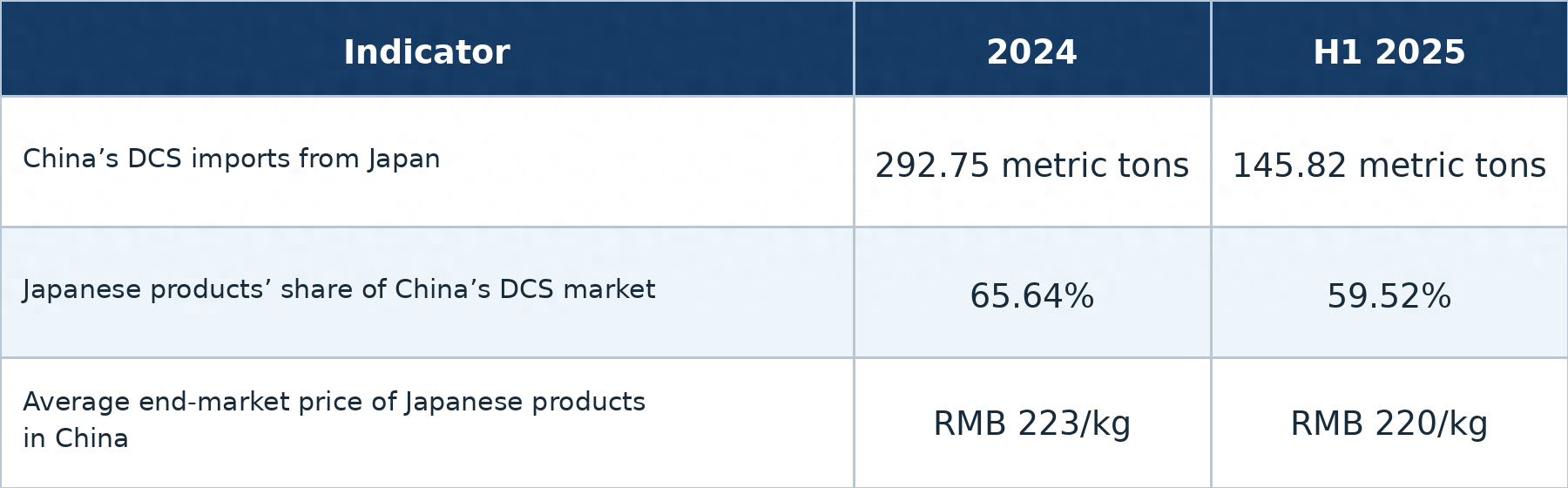
China’s imports of Japanese DCS and market indicators
These figures show that Japan remains an important source of supply for the Chinese market. They do not prove that more than 60% of Japanese DCS sales depend on China. The preliminary determination specifically notes that the relevant customs tariff code also covers other products. The quantities and prices in the table are based on third-party industry data provisionally accepted by the investigating authority, so the total trade value under the tariff code should not be treated as DCS trade value.
I did not find enough public information to calculate the Chinese-market dependence of Japan’s overall DCS sales. Shin-Etsu disclosed that the Chinese market accounted for about 10% of group revenue from April to June 2026, but that figure covers all products. It cannot be used as a proxy for the share of DCS revenue generated in China, much less for the share of revenue covered by these measures.
The preliminary data can nevertheless help estimate the order of magnitude. Multiplying 2024 import volume by that year’s average end-market price gives approximately RMB 65 million. This is only a rough estimate of the corresponding sales value: imports and end-market sales differ because of inventory and timing, and end-market prices include distribution margins. It is therefore neither an accurate measure of Japanese suppliers’ export revenue nor an estimate of expected losses. Even so, the figure indicates that the case directly concerns a relatively small market for a specialized material.
The most immediate pressure on Japanese suppliers is the trade-off between orders and profit. Importers initially bear the cash burden of the security deposits and may then ask suppliers to cut prices or reduce their purchases. If Japanese companies lower prices to retain customers, their margins will shrink; if they hold prices, they may lose orders. How the burden is ultimately shared among Japanese suppliers, import distributors, and Chinese wafer fabs will depend on contract terms and the availability of alternative supply.
The more significant concern is the potential loss of customers over the medium to long term. Because electronic materials require customer qualification, once Chinese wafer fabs qualify domestic materials and establish stable procurement relationships, Japanese suppliers may not easily regain share even if they later recover their price competitiveness. They could lose not only current-year sales but also supply opportunities tied to future capacity expansion and new production lines.
The impact may also extend to customer collaboration. Long-term supply relationships help materials producers understand customers’ requirements for new processes and conduct joint qualification work. If Chinese customers gradually shift to domestic suppliers, Japanese companies will have fewer opportunities to participate in such collaboration. This is a potential long-term competitive loss, but it cannot yet be quantified as a realized financial loss.
Chinese downstream manufacturers also face costs. For processes where alternative materials have not yet completed qualification, wafer fabs may still need to buy Japanese products and absorb part of the additional burden. Existing domestic production capacity does not mean that every customer and every process can switch immediately. Whether the measures achieve their intended industrial effect will ultimately depend on the stability of domestic products, the pace of qualification, and suppliers’ ability to deliver.