

Today, China’s Ministry of Commerce and four other government agencies issued a notice revising the Catalogue of Precursor Chemicals Subject to Export Controls to Specific Countries (Regions), further expanding controls on the export of fentanyl-related precursor chemicals.
Issuing authority: Department of Security and Controls
Document No.: MOFCOM Announcement No. 40 of 2026
Date: September 22, 2026In order to further strengthen the administration of precursor chemical exports, and pursuant to the Interim Provisions on the Administration of Precursor Chemical Exports to Specific Countries (Regions), the Ministry of Commerce, Ministry of Public Security, Ministry of Emergency Management, General Administration of Customs, and National Medical Products Administration have decided to revise the Catalogue of Precursor Chemicals Subject to Export Controls to Specific Countries (Regions) by adding two substances — methyl 1-phenethyl-4-oxo-3-piperidinecarboxylate and ethyl 1-phenethyl-4-oxo-3-piperidinecarboxylate — to Part I of Annex 1.
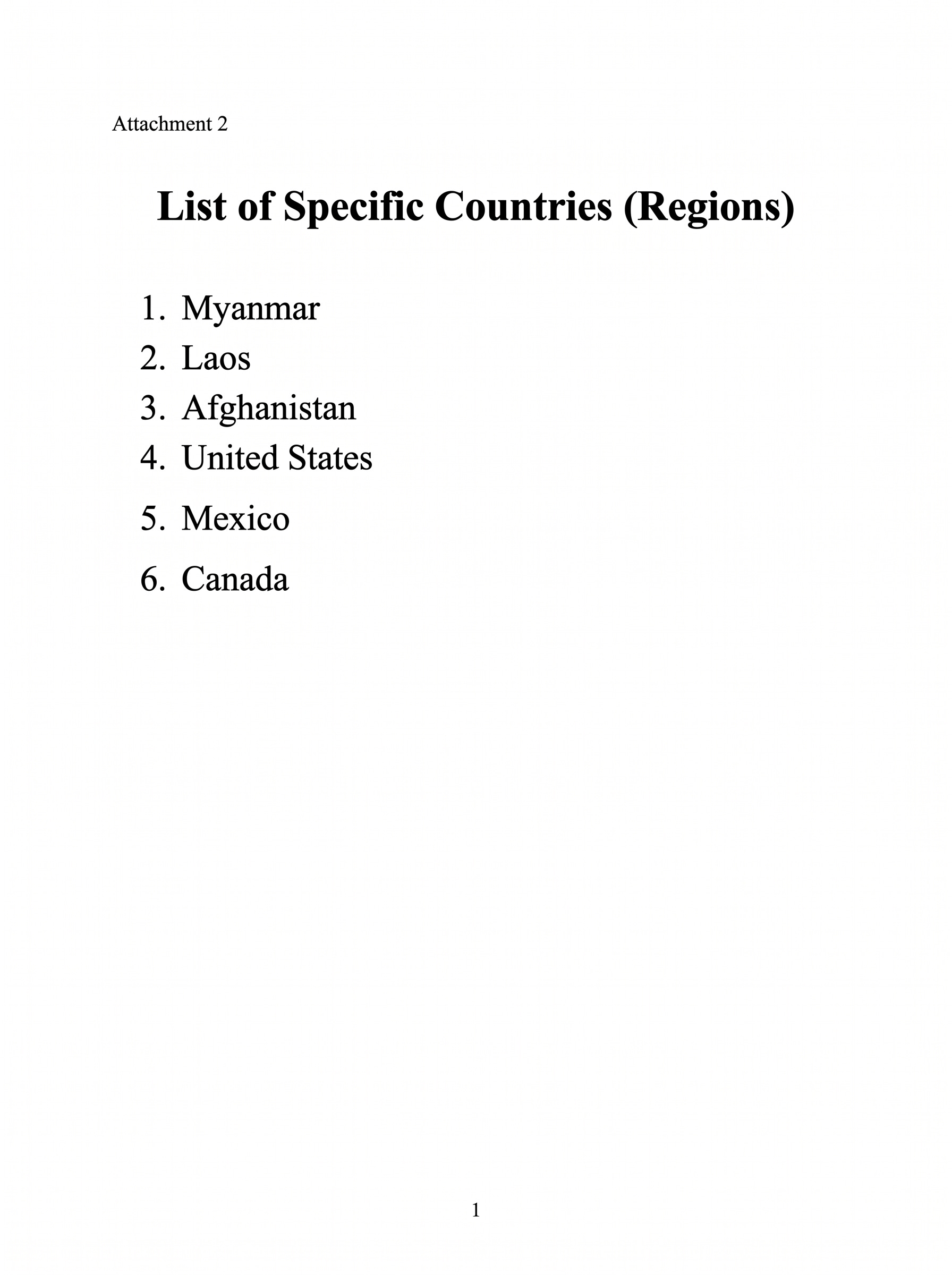
The revised catalogue is hereby published. Effective from the date of this announcement, exports of chemicals listed in Part I of Annex 1 to the United States, Mexico, and Canada, as well as exports of chemicals listed in Part II of Annex 1 to Myanmar, Laos, and Afghanistan, must obtain licenses in accordance with the Interim Provisions on the Administration of Precursor Chemical Exports to Specific Countries (Regions). No license is required for exports to other countries or regions.
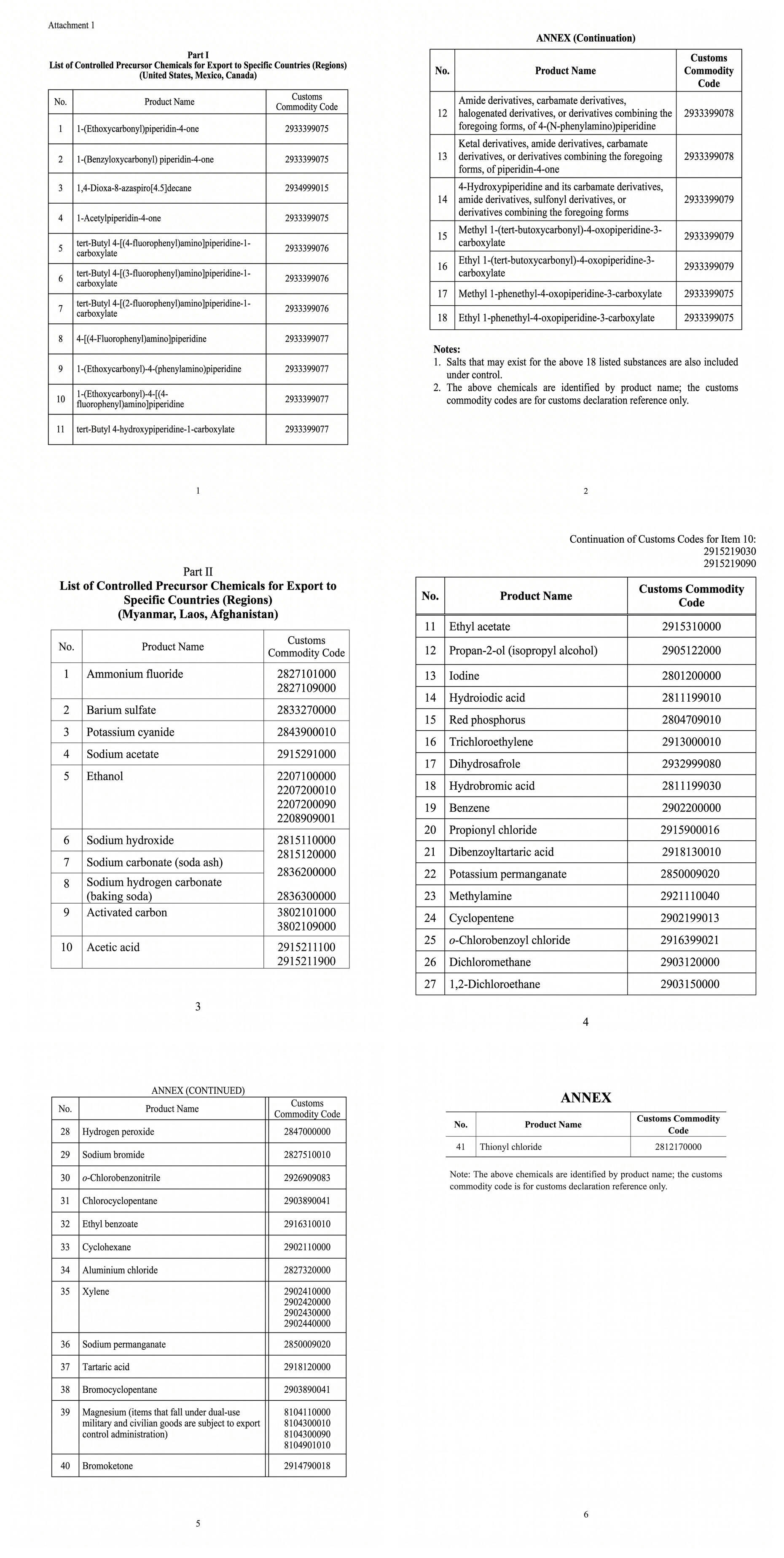
Since China and the United States resumed negotiations in 2025, China has gradually introduced country-specific export licensing requirements for fentanyl precursors destined for North America. It has also brought some chemicals not yet subject to uniform international controls under its regulatory framework, while allowing Chinese and U.S. law-enforcement agencies to cooperate on specific cases involving companies and individuals.
In June 2025, China placed two key chemicals that can be used in fentanyl production — 4-piperidone and 1-Boc-4-piperidone — under control.
Following the leaders’ meeting in late October 2025, China committed to preventing certain designated chemicals from being shipped to North America and to strengthening controls over the global export of other related chemicals. In exchange, the United States reduced its fentanyl-related tariff on Chinese goods from 20% to 10%, effective November 10.
On November 10, 2025, the Ministry of Commerce and four other agencies added the United States, Mexico, and Canada to the list of “specific countries” and established a separate list covering 13 precursor chemicals. Exports of these products to the three countries became subject to licensing requirements. Compared with general domestic scheduling, this created additional administrative tools, including export declarations, scrutiny of intended uses, end-user verification, and the ability to reject suspicious transactions.
On May 22, 2026, China added another three chemicals to the list and issued risk alerts covering eight additional chemicals that had not yet been formally scheduled but could potentially be diverted for illicit drug production.
Ahead of the latest leaders’ meeting tomorrow, China has now added another two chemicals. Across the three rounds of measures, the special export-licensing list applicable to the United States, Mexico, and Canada has expanded from 13 substances to 16, and now to 18.
China and the United States have also stepped up law-enforcement cooperation. In May 2026, Chinese and U.S. counternarcotics authorities jointly investigated a transnational drug case, resulting in the arrest of five suspects in the two countries and the seizure of narcotics. The two sides subsequently increased personnel exchanges, case-specific cooperation, and intelligence sharing. U.S. internal materials have also attributed several enforcement actions involving Chinese pharmaceutical and chemical companies to bilateral cooperation.
Sounds nice. Hope it has a positive impact. However, it sounds like a lot of this stuff could still reach America through a third country.