

On May 19, Chinese Foreign Ministry spokesperson Guo Jiakun chaired the regular press briefing. A reporter asked about reports that the Chinese and U.S. presidents exchanged views on AI governance during their meeting and agreed to pursue dialogue and cooperation on the issue.
Guo Jiakun responded that, as two major AI powers, China and the United States should work together to promote the development and governance of artificial intelligence, and ensure that AI better serves the progress of human civilization and the common well-being of the international community.
He added that during President Trump’s visit to China, the two leaders held constructive discussions on AI-related issues and agreed to launch a government-to-government dialogue on AI.
The White House has not formally announced the dialogue yet. But President Trump and Treasury Secretary Scott Bessent has kind of confirmed it informally:
Bret Baier(Fox News):
On AI, was there any agreement about any kind of guardrails that China and the U.S. might agree to so that AI does not go crazy?Donald Trump:
We talked about it. Yes, we talked about it. AI is mostly a great thing. Mostly.And we are leading China. We talked about that. We are leading China by a lot. I gave AI companies the right to build their own electricity-producing plants. That is a big deal. They can now generate their own electricity, which we could never have gotten from the grid.
Now you have these very rich companies, headed by lots of geniuses, building electric plants. Because of that, we are leading China by a lot in the AI race.
Now it is mostly the two of us. Other nations are in it, but mostly it is the two of us. Whoever wins the AI race — and we are going to win it. If we are smart, we are going to win it. If we are not smart, we are not. But we are leading by a lot.
We talked about that last night. President Xi was very surprised at how well we have done with AI, because when it started, they thought they had taken this gigantic lead. And now, of course, we are substantially ahead of them in AI.
Bret Baier:
But do you think there will be some buy-in, some setup, guardrails or something?Donald Trump:
That could be. We talked about it. But at the same time, we are competing. So it is a little hard to say, “Let’s put on guardrails,” when we are competing with each other. It does not really work that way too much.But AI, if you look at medicine, some of the things coming up in medicine, some of the cures they are coming up with — people would never have gotten there otherwise. It is going to be mostly a good thing, but we want to have some guardrails.
KERNEN(CNBC): Let’s get back to our conversation with Treasury Secretary Bessent. I asked him, you probably saw if you were watching earlier, how he sees the U.S. navigating through the A.I. revolution.
BESSENT: Well, all three of the leading companies, Anthropic, OpenAI and Google/Gemini, their large language models are increasing in power very quickly. We saw a step function jump with Anthropic Mythos. I think we’re going to see a big step function jump with OpenAI’s next release. And I think in a few months, we’re going to see a big step function jump with Gemini.
And, Joe, first of all, the good news is the U.S. is the undisputed leader in the world here. We have the greatest A.I. companies. We’re actually going to be discussing the A.I. guardrails with the Chinese. It will, because the Chinese are substantially behind us, but they have a very advanced A.I. industry here. So the two A.I. superpowers are going to start talking. We’re going to set up a protocol in terms of, how do we go forward with best practices for A.I. to make sure non-state actors don’t get ahold of these models.
And you know, Joe, what I will tell you is all three of the big players have been very good partners with the U.S. government because what we don’t want to do is stifle innovation. So our responsibility is to come up with the highest performance calculus, where we can get the most innovation and the highest level of safety. And we, I am very satisfied that we are well on our way to that. Everything has been voluntary by the companies, and they have been very good partners with the U.S. government.
My previous pieces on U.S.-China AI dialogue:
Is Mythos Restarting U.S.-China AI Safety Dialogue?
China and the US agreed to hold the 2nd intergovernmental dialogue on AI
A few thoughts on the first Sino-US intergovernmental dialogue on AI
China’s readout of the first Sino-U.S. intergovernmental dialogue on AI
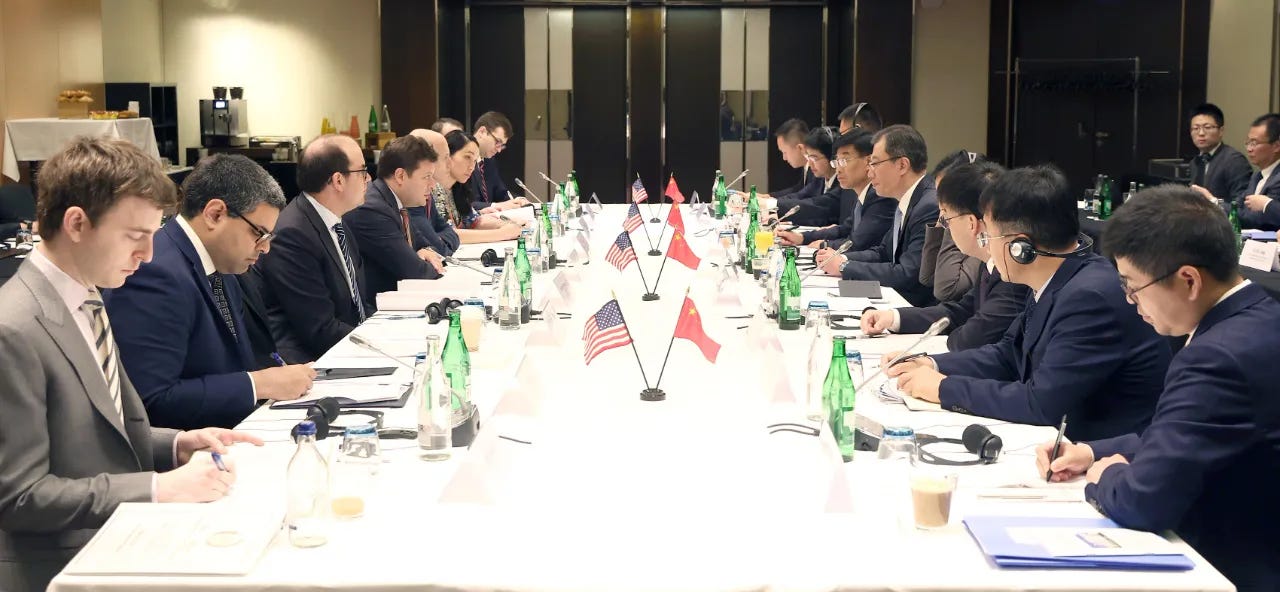
Some background:
on May 14 2024, China and the U.S. held their first-ever government-to-government AI dialogue. This was the first formal AI communication mechanism established at the government level between the two countries.
Both sides released readouts afterward, but overall, this felt much more like a “setting up the table” meeting rather than one designed to produce immediate deliverables.
Based on the public information available, there were no major substantive agreements or concrete cooperation outcomes. Beyond acknowledging that AI brings both enormous opportunities and serious risks — and that global governance is needed — there was no joint statement, no specific cooperation project, and no new rules framework. That was not particularly surprising. U.S.-China relations are already highly competitive and tense, and AI has become one of the most sensitive areas in both technology and national security. In that context, the fact that the two sides were still able to sit down and calmly discuss AI governance and safety was itself already a meaningful step.
That said, the tone of the talks actually seemed fairly positive. The U.S. described the discussions as “candid and constructive,” while the Chinese side called them “in-depth, professional, and constructive.” Both sides also signaled interest in continuing the dialogue. The U.S. specifically said that keeping communication channels open on AI risks and safety is an important part of “responsibly managing competition,” while China emphasized continued implementation of the consensus reached by the two leaders in San Francisco.
Of course, there was still some friction beneath the surface. The U.S. side explicitly raised concerns about the “misuse” of AI, including by China. While the readout did not go into detail, this likely referred to familiar U.S. concerns around surveillance technologies, disinformation, and human rights issues. Meanwhile, the Chinese side made clear that it raised strong objections to U.S. restrictions and pressure on China’s AI sector, including export controls on AI chips.
The two sides also approached the dialogue from somewhat different angles.
On the Chinese side, the talks were led mainly by the Department of North American and Oceanian Affairs at the Foreign Ministry, rather than by the agencies that usually handle technical AI governance negotiations. Other agencies — including the Ministry of Science and Technology, NDRC, CAC, and MIIT — participated as supporting agencies. Overall, China seemed to view the AI dialogue more as part of the broader effort to stabilize U.S.-China relations, somewhat similar to past climate dialogues: both a technical discussion and a “cooperation pillar” within the broader bilateral relationship.
The U.S. side, by contrast, approached it much more through a “national security + technology governance” lens. The talks were jointly led by the White House National Security Council and the State Department, with participation from senior officials focused on AI safety and critical technologies. That suggests Washington sees the dialogue more as a specialized governance and risk-management channel focused on AI safety, misuse, and security concerns.
The two sides also still differ significantly on what “global AI governance” should look like.
China continues to push the framework outlined in its Global AI Governance Initiative, emphasizing that the United Nations should play the central role and that AI rules and standards should be based on “broad consensus,” rather than being driven by a small group of countries.
The U.S., meanwhile, did not directly endorse a UN-centered approach to global AI governance. Washington also appears more cautious about using hard terms like “rules” or “standards,” preferring broader language around building “global consensus.”
Later, after President Trump returned to office, many people expected the U.S. might restart a broader U.S.-China AI safety dialogue mechanism. In reality, however, the U.S. government remained relatively lukewarm about it. Over the past period, the real center of gravity in U.S.-China AI negotiations has still been much more focused on practical issues like chip export controls and compute restrictions.
At the November 2024 APEC Summit in Lima — the final face-to-face meeting between Biden and Xi— the White House announced that “the two sides affirmed the need to maintain human control over decisions regarding the use of nuclear weapons.” In practice, this marked the first time that the United States and China, at the leader level and in formal political language, confirmed that artificial intelligence should not be allowed to autonomously make decisions on nuclear strikes.