

On February 3, 2026, the U.S. Commerce Department’s Bureau of Industry and Security (BIS) issued a final rule amending the Export Administration Regulations (EAR), formally removing Cambodia from Country Group D:5.
D:5 is the bucket in the U.S. export control system reserved for U.S. arms-embargoed countries. When Cambodia was still in D:5, military exports were basically banned outright, and dual-use items were subject to a “presumption of denial.” That also included the controlled AI chips restricted under Biden-era rules for D:5 countries.
Being taken out of D:5 is therefore a clear loosening of U.S. export controls toward Cambodia. That said, Cambodia is still in D:1 (national security concerns), and the EAR’s restrictions on military and military-intelligence end uses and end users under Sections 744.21 and 744.22 remain fully in force.
Under the new rules, exports of dual-use items to Cambodia are no longer automatically denied, but they’re also not treated like exports to U.S. allies. Instead, they move to case-by-case licensing. Some license exceptions that were previously unavailable may now be used, as long as the conditions are met.
In practical terms, this means that controlled chips going to Cambodia — as long as they’re not destined for Chinese subsidiaries in Cambodia and not tied to Cambodian military or intelligence end users or uses — will likely be reviewed the same way as exports to countries like the UAE or Saudi Arabia.
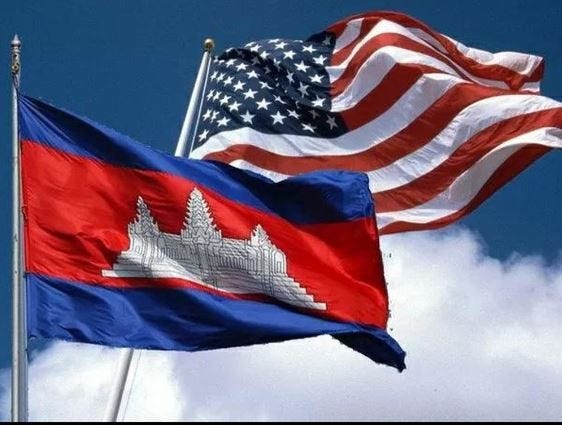
For Cambodia, this is clearly good news. Late last year, I attended an event at Singapore’s ISEAS and briefly spoke with Dr. Sophal Try, Director General of Science and Technology at Cambodia’s Ministry of Industry and Technology. He said Cambodia places a lot of importance on building a sovereign large-language model that integrates Khmer language and local culture, and on developing domestically controllable HPC infrastructure and cloud services.
But because Cambodia was stuck in D:5, it simply couldn’t access high-end NVIDIA chips and had to wait for breakthroughs in Chinese domestic alternatives.
In addition, Cambodia has one of the most relaxed cross-border data transfer regimes in ASEAN, especially for AI services.
With Cambodia now out of D:5 and able to apply normally for NVIDIA chips, this could unlock a real growth window for its cloud and AI ecosystem.
According to the U.S. government, Cambodia was removed from D:5 because it has made “concrete efforts to promote peace and security,” including re-engaging with the United States on defense cooperation and cooperation against transnational crime.
Strictly speaking, though, this isn’t brand-new news. On October 26 last year — the same day President Trump arrived in Kuala Lumpur for the ASEAN summit — the White House had already announced the lifting of the U.S. arms embargo on Cambodia. The next day, the State Department’s Directorate of Defense Trade Controls (DDTC) said that Cambodia-related ITAR cases would shift to case-by-case review and began the rulemaking process to remove Cambodia from ITAR Section 126.1. On November 7, the State Department issued the final rule, writing that change into federal law.
In practice, Cambodia had already stopped being treated as a D:5 country. The EAR is explicit: if there’s any inconsistency between the D:5 list and the State Department’s arms-embargo list, the State Department list controls. So once Cambodia was formally removed from ITAR 126.1, its D:5 status effectively disappeared, even if an “X” still lingered on the EAR country chart. To avoid confusion for exporters and to align the two systems, Commerce moved to delete that “X” entirely.
BIS submitted the final Cambodia rule for interagency review on January 6, completed that process on January 27, and issued the final amendment today, which takes effect immediately upon publication in the Federal Register on February 4.
It’s also worth noting what was happening geopolitically at the time. When the U.S. announced the end of the Cambodia arms embargo last October, Trump helped broker a ceasefire between Thailand and Cambodia, ending border clashes that had caused hundreds of casualties and large refugee flows. The U.S. and Cambodia also signed a trade agreement: Cambodia eliminated tariffs on U.S. goods, while U.S. tariffs on Cambodian exports were capped at 19%. Phnom Penh went out of its way to reciprocate — Prime Minister Hun Manet publicly nominated Trump for the Nobel Peace Prize and announced the purchase of 10 Boeing 737 aircraft.
One clause in that trade agreement stands out. Article 3.3 says Cambodia must consult the United States before entering into a new digital trade agreement with another country that jeopardizes essential U.S. interests. Many readers will find this familiar — it looks very much like a transplanted version of the USMCA’s famous “poison pill” clause aimed at China.
Under USMCA Article 32.10, if Canada or Mexico signs a free trade agreement with a “non-market economy” (i.e., China), the U.S. can exit the agreement and replace it with bilateral deals. In trade negotiations, this is a classic poison-pill provision designed to limit a partner’s future strategic autonomy.
Cambodia also committed, in the same agreement, to cooperate with the U.S. on export controls, sanctions, and investment security. Under Chapter 5, Cambodia agreed to align with U.S. rules on sensitive technologies, to enforce case-by-case controls when requested, and to ensure its companies don’t become conduits for U.S. export-control evasion. On sanctions, Cambodia pledged to limit dealings with entities on the BIS Entity List, OFAC’s SDN list, and other U.S. sanctions lists. On investment transparency, Cambodia agreed — under confidentiality arrangements — to share information on third-country investment activity in Cambodia, in exchange for deeper cooperation and greater flexibility in U.S. licensing and enforcement.
China clearly noticed. On November 18, 2025, the second meeting of the China–Cambodia FTA Joint Committee was held in Beijing. Vice Minister Li Chenggang met the Cambodian delegation. The official readout says the two sides exchanged views on recent trade agreements with third parties, and Cambodia provided explanations on issues of concern. Li said China welcomes Cambodia engaging economically with other partners, including the U.S., but any agreement should not harm global trade, regional cooperation, or China’s interests.
This is far from the first time the U.S. has removed a country from its arms-embargo list. These decisions are not legalistic; they’re fundamentally geopolitical.
After the Cold War, the U.S. rapidly adjusted export controls on former Eastern Bloc states. In 1991, Washington lifted 30-year arms embargoes on Poland, Hungary, and Czechoslovakia, saying defense exports would strengthen U.S. security and promote world peace. In 1994, Bulgaria, Romania, Estonia, Latvia, Lithuania, and Albania were also removed, with military exports shifting from presumption of denial to case-by-case review. These countries were rapidly integrating into Western political and security structures — many later joined NATO and the EU.
In Asia, India followed a similar path. Once restricted under D:2 and D:3, India was designated a Major Defense Partner under Obama, and in 2018, Trump elevated India into A:5 (STA-1), making it the 37th A:5 country. Most NS-controlled high-tech exports no longer required licenses.
Vietnam, once under a full arms embargo after the Vietnam War, was removed from D:5 in 2016 when Obama lifted the embargo during a visit to Hanoi — widely seen as driven by South China Sea tensions and U.S. efforts to balance China.
The pattern is clear: removing a country from D:5 reflects a holistic U.S. judgment — about political alignment, strategic utility, and whether the country helps counter U.S. rivals.
Seen in that light, Cambodia’s exit from D:5 fits squarely into broader shifts in U.S.–Cambodia relations. Under Hun Sen, ties with Washington deteriorated while ties with Beijing deepened. China is now Cambodia’s largest trade and investment partner, with billions invested through the Belt and Road, including the $1.7 billion Funan Techo Canal. Cambodia is widely seen as one of China’s closest ASEAN partners.
Since Hun Manet took office in 2023, that posture has begun to change. Educated at West Point, he appears to be experimenting with a “bamboo diplomacy” approach — keeping close ties with China while leaning toward the U.S. for economic and security benefits. He met U.S. business leaders at the UN early on, proposed restarting the Angkor Sentinel joint exercise, and welcomed U.S. naval visits. In January 2026, a U.S. littoral combat ship even visited Ream Naval Base — a base upgraded with Chinese involvement.
In parallel, the U.S. updated ITAR 126.1 last October, formally lifting the arms embargo imposed in 2021. Diplomatic ties have warmed as well. 2025 marked the 75th anniversary of U.S.–Cambodia relations, with frequent high-level exchanges. In November, Assistant Secretary Michael DeSombre visited Phnom Penh to discuss trade, defense cooperation, and transnational crime.
In early 2026, DeSombre announced $45 million in U.S. aid to Cambodia and Thailand to support the peace agreement, border stabilization, demining, and crackdowns on telecom fraud and drug trafficking — an area where Cambodia has stepped up cooperation as scams targeting U.S. citizens surged.
With Cambodia removed, Myanmar is now the only Southeast Asian country left in D:5. The rest of the list includes China, Russia, Belarus, North Korea, Iran, Syria, Venezuela, Cuba, and others — a reminder that D:5 is less about technology than about geopolitics.