

On 23 July 2026, the Council of the European Union adopted its twenty-first package of restrictive measures against Russia. The package included 14 companies based in mainland China and Hong Kong. According to the EU, these firms had helped Russia circumvent export controls, particularly in relation to microelectronics, computer numerical control machine tools and semiconductor-manufacturing equipment.
Beijing responded the following day. On 24 July, China’s Ministry of Commerce (MOFCOM) issued Announcement No. 30 of 2026, adding 14 EU entities to China’s Export Control List with immediate effect. The announcement itself is terse. It prohibits Chinese exporters from supplying controlled dual-use items to the named entities; bars overseas parties from transferring Chinese-origin dual-use items to them; orders any transactions already under way to stop immediately; and leaves open a licensing channel for exceptional cases.
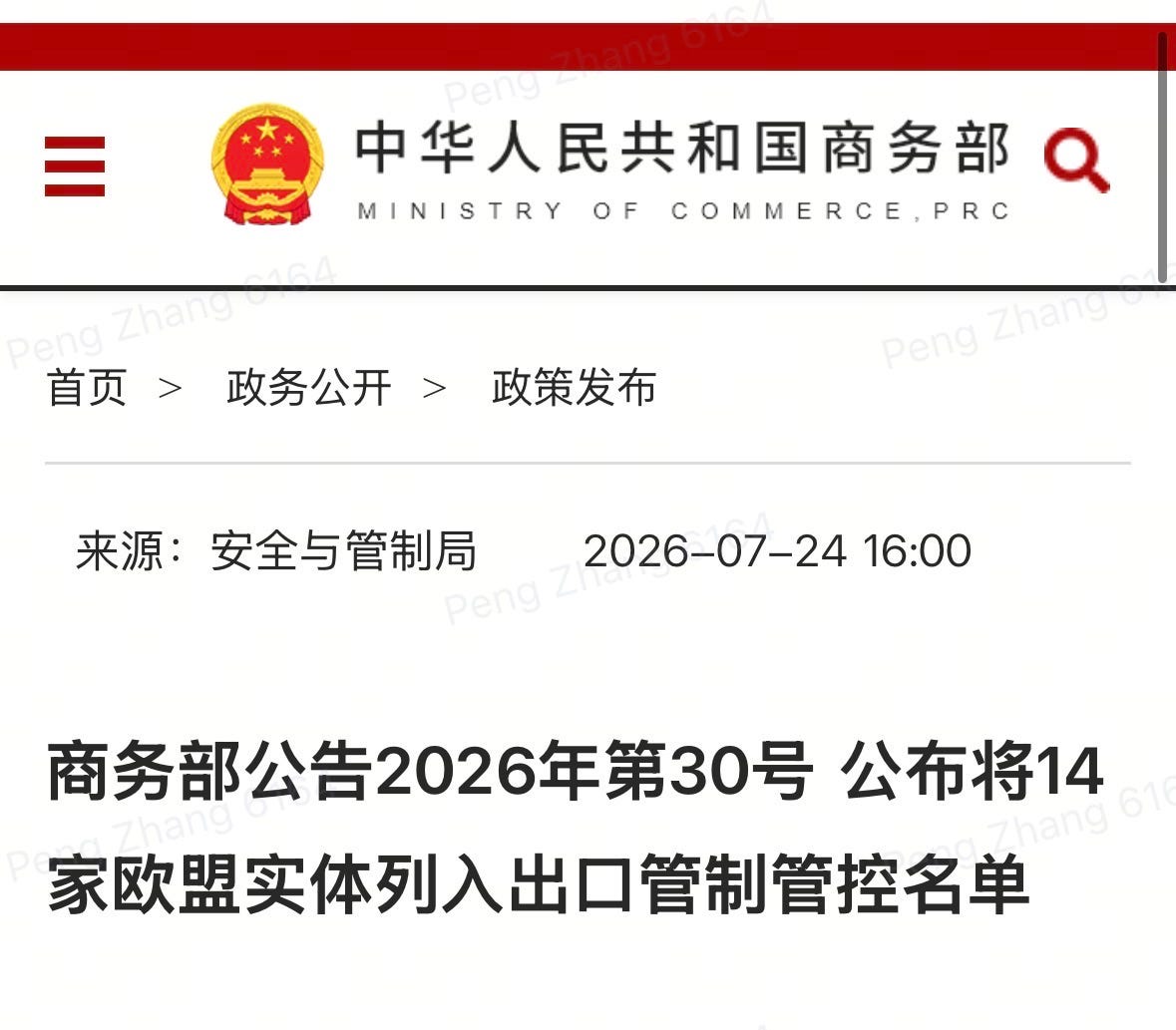
In its public explanation, MOFCOM described the measure as a response to what it called the EU’s “egregious behaviour”. The ministry cited the Export Control Law and the Regulations on Export Control of Dual-Use Items as its legal basis.
The speed, scale and composition of the Chinese list suggest that several considerations were at work. They do not all operate on the same timetable, and some are more clearly supported by the available evidence than others.
The 14 entities are spread across eight EU member states:
● Germany: Rheinmetall, Sindlhauser Materials and Antraco Chemie
● France: InPACT, III-V Lab and Cavok UAS
● Italy: Lafert and Garnet
● Poland: Vigo Photonics and Wroclaw University of Science and Technology
● The Netherlands: IHC Merwede
● The Czech Republic: TATRA TRUCKS
● Bulgaria: Opticoelectron Group
● Lithuania: Ekspla
All eight countries have made national trade, financial or defence-industrial commitments in support of Ukraine. That common feature is relevant, although it does not by itself establish why each entity was selected.
By sector, the list is weighted towards defence and dual-use manufacturing, photonics, infrared systems, lasers and specialist materials. Four entities can broadly be described as defence primes or systems integrators: Rheinmetall, TATRA, Cavok UAS and Opticoelectron. Four operate in photonics, infrared detection or lasers: III-V Lab, Vigo Photonics, Ekspla and, again, Opticoelectron. Sindlhauser, Antraco, Garnet and InPACT fall within materials, chemicals or specialist engineering. Lafert and IHC Merwede manufacture industrial motors and marine systems respectively. Wroclaw University of Science and Technology is the only academic institution.
The individual entities and their most plausible areas of exposure are as follows.
1. Lafert S.p.A. — Italy
Lafert manufactures high-efficiency industrial motors, including IE4 and IE5 permanent-magnet motors, and is part of the Sumitomo group. Its clearest potential exposure is to sintered neodymium-iron-boron magnets and the neodymium, praseodymium, dysprosium and terbium used in high-performance magnet systems. China remains the leading supplier across much of this value chain. Electrical steel may be another area of exposure, although the extent of Lafert’s reliance on Chinese material cannot be established from public information alone.
2. Garnet S.r.l. — Italy
Garnet is an industrial-engineering and specialist-machinery supplier based in Concorezzo. Compared with several other companies on the list, its direct exposure to Chinese controlled raw materials is less obvious. The more likely risk is indirect, through precision components, electronic subassemblies and customer requirements concerning the origin of controlled content.
3. Sindlhauser Materials GmbH — Germany
Sindlhauser supplies sputtering targets, lanthanum hexaboride ceramics and cathodes, bonded rare-earth metals, and tungsten, tantalum and molybdenum components used in coating and vacuum applications. This is one of the clearer supply-chain targets. The company’s product range draws directly on materials in which Chinese processors have a large or dominant market position, including LaB6 feedstock, rare-earth metals and refractory metals.
4. Rheinmetall AG — Germany
Rheinmetall is the largest company on the list and one of Europe’s principal defence contractors, with businesses spanning ammunition, armoured vehicles, air defence and military electronics. Potentially affected inputs include antimony used in ammunition, tungsten used in penetrators and armour, rare-earth materials, magnesium, and gallium- or germanium-containing electronic components. China accounted for a substantial majority of refined antimony production in 2024–2025, although Rheinmetall’s stockpiling and diversification efforts since 2024 may reduce its immediate vulnerability.
5. Antraco Chemie-Handelsgesellschaft mbH — Germany
Antraco Chemie is a Duisburg-based trader in specialty and fine chemicals. Its exposure is likely to arise from direct sourcing relationships with Chinese chemical producers and from its role as an intermediary. The prohibition on overseas transfers of Chinese-origin controlled items is particularly relevant to a trading company, because it can apply even where the goods do not move directly from China to the listed end user.
6. InPACT S.A. — France
InPACT, based in Saint-Marcel in Savoie, specialises in metallurgy and precision-machined components. Its possible exposure lies in alloying materials such as tungsten, molybdenum and certain rare-earth products, as well as specialist steels containing controlled inputs. Public information does not reveal how much of this material the company sources directly or indirectly from China.
7. III-V Lab — France
III-V Lab is a joint research laboratory established by Thales, Nokia Bell Labs and CEA-Leti. It works on gallium arsenide, indium phosphide and gallium nitride epitaxy and related compound-semiconductor components. The laboratory therefore has relatively direct exposure to gallium, indium, germanium and high-purity precursors. Gallium is the most obvious pressure point: China supplies more than 90 per cent of global primary production and has required export licences for gallium-related items since 2023.
8. Cavok UAS — France
Cavok UAS develops professional and defence-oriented unmanned aircraft, including first-person-view systems, from its base in Sainte-Menehould. Its exposure is likely to be concentrated in motors, electronic speed controllers, cameras, infrared or optical modules and other subassemblies that may contain Chinese components. Some of these parts can be replaced, but redesign and requalification are rarely immediate, especially for equipment supplied to military customers.
9. Vigo Photonics S.A. — Poland
Vigo Photonics produces mercury-cadmium-telluride and indium-arsenide-antimonide infrared detectors, epitaxial wafers and infrared modules. Its manufacturing processes depend on specialised semiconductor feedstocks, including gallium, indium, germanium, cadmium and tellurium. Not all of these materials are covered to the same extent by current Chinese controls, but the company is clearly situated in a sector where Chinese licensing decisions can affect availability, lead times and prices.
10. Wroclaw University of Science and Technology — Poland
The university conducts research in materials science, photonics, semiconductors and cybersecurity. Its direct consumption of strategic raw materials is unlikely to be comparable with that of an industrial manufacturer. The more significant consequences may concern research-grade reagents, test wafers, lasers and semiconductor components, as well as access to Chinese partners and joint programmes. The listing may also discourage Chinese institutions from entering or continuing collaborations with the university.
11. IHC Merwede Holding B.V. (Royal IHC) — the Netherlands
Royal IHC builds dredgers, offshore installation vessels and other specialised maritime equipment. Relevant areas of exposure may include permanent-magnet systems used in propulsion and dredging drives, electrical steel and components associated with deep-sea mining equipment. The precise Chinese-origin content of individual vessels will vary by programme and supplier.
12. TATRA TRUCKS a.s. — Czech Republic
TATRA manufactures military and heavy-duty truck chassis, including its Phoenix and Force ranges, and supplies customers in the Czech Republic, Belgium, the Netherlands and Ukraine. Its potential exposure includes tungsten and molybdenum used in high-strength applications, permanent magnets in drive and control systems, and Chinese-origin content in infrared or optronic equipment supplied by third parties.
13. Opticoelectron Group — Bulgaria
Opticoelectron produces optical and optoelectronic equipment, including night-vision devices, thermal sights and gunsights. Germanium optics, infrared-transparent crystals, gallium arsenide and antimony compounds are all relevant to these product lines. China’s position in refined germanium and antimony makes the company a comparatively direct target of material-based export pressure.
14. Ekspla UAB — Lithuania
Ekspla manufactures femtosecond, picosecond and nanosecond lasers, as well as optical parametric chirped-pulse amplification and optical parametric oscillator systems. These products use nonlinear optical crystals such as BBO, LBO, KTP and lithium niobate. Chinese growers are among the leading global suppliers of these crystals, although alternative producers exist in Europe, Japan and elsewhere.
China’s Export Control List is narrower than the Unreliable Entity List. Inclusion does not, by itself, prevent a company from operating in China, freeze its assets or automatically extend to every subsidiary. Its main effect is on access to controlled Chinese-origin inputs.
The first layer is the direct export ban. Chinese suppliers must suspend exports of controlled dual-use items to the 14 entities, and transactions already under way were required to stop from 24 July. Companies such as Sindlhauser, Antraco, Vigo Photonics, III-V Lab, Ekspla and Opticoelectron are likely to feel this effect most directly. Their options include applying to MOFCOM for an exceptional licence or shifting procurement to suppliers in Japan, South Korea, the EU or the United States. Whether those alternatives are commercially viable will differ sharply by material and product grade.
The second layer is the restriction on overseas re-transfers. Distributors and resellers outside China may not supply the listed entities with Chinese-origin dual-use items. This potentially affects all 14 entities, including firms that do not buy directly from Chinese exporters. Rheinmetall, TATRA, Royal IHC and Lafert, for example, may receive controlled Chinese-origin content through European, American or Japanese intermediaries. Suppliers will therefore need stronger end-user declarations, origin audits and contractual restrictions. The compliance burden resembles some aspects of US export-control practice, although it should not be treated as legally equivalent to the US Foreign Direct Product Rules.
The third layer consists of contractual, banking and insurance effects. Customers, lenders and insurers may add the Chinese list to their screening systems even where a particular transaction does not involve a controlled item. Delivery dates and prices may need to be renegotiated. This is especially relevant to Rheinmetall’s NATO and Ukraine-related contracts, TATRA’s military-vehicle orders and Royal IHC’s long-term offshore projects. Companies may respond through public disclosures, hardship or force-majeure provisions, and formal plans to remove Chinese-origin content from sensitive product lines.
The fourth layer is reputational and institutional. Chinese partners may become reluctant to work with Wroclaw University of Science and Technology, III-V Lab or listed companies with joint ventures or research ties in China. The likely responses are fairly conventional: appointing a designated compliance lead, reviewing joint projects, separating controlled and non-controlled work, and engaging MOFCOM on the availability of licences.
The economic effect will not be uniform. Rheinmetall, with more than €10 billion in annual group revenue in 2025, is by far the largest listed company. Royal IHC, Lafert, TATRA and the industrial groups behind III-V Lab operate on a different but still substantial scale. Vigo Photonics, Ekspla, Opticoelectron and Sindlhauser are smaller specialist suppliers, broadly in the tens to low hundreds of millions of euros in revenue. For these firms, the loss of a particular Chinese input may be more painful as a share of turnover, even if the absolute economic value is smaller. The university’s exposure is primarily institutional rather than financial.
Alternative supplies of gallium, germanium, antimony, rare-earth materials and nonlinear crystals do exist. The question is less whether substitution is technically possible than how long it takes, whether the replacement meets the required specification, and at what cost. For some high-purity materials or specialised optical crystals, qualification can take years and unit costs can increase several-fold. Larger defence companies may have inventories and long-term procurement arrangements. Smaller photonics and materials firms are less likely to have the same buffers.
The overseas re-transfer clause deserves particular attention. Its wording is broad and resembles language used in China’s 2024–2026 actions against US companies. In practical terms, an EU distributor handling controlled Chinese-origin goods will need to screen the 14 entities as end users and consignees. The compliance risk therefore rests not only with the original Chinese exporter but also with intermediaries and the final recipient.
What to watch next?Three wider consequences stand out.
First, China has demonstrated that it can respond to an EU listing within a day and on a list-for-list basis. Future EU sanctions packages that include Chinese entities are therefore more likely to trigger a targeted Chinese control-list response rather than a prolonged diplomatic protest. This changes the calculation for member states that may previously have regarded the inclusion of Chinese companies as a relatively low-cost measure.
Second, the listing of a public university crosses a line that MOFCOM had largely avoided in its earlier measures against European entities. It puts national research ministries and universities on notice that Chinese countermeasures can reach laboratory supply chains and institutional partnerships. Researchers working in materials science, photonics and semiconductors will need to pay closer attention to dual-use classification in future collaborations with Chinese counterparts.
Third, the announcement leaves important implementation questions unanswered. MOFCOM has not yet explained what will qualify as an “exceptional case”, whether spare parts and after-sales services for previously installed Chinese-origin equipment are covered, or how transactions routed through Hong Kong will be treated. Its first licensing decisions will matter more than the wording of the announcement in determining the practical severity of the measure.
Appendix A. Full English translation of MOFCOM Announcement No. 30 of 2026
Translation provided for reader convenience; not an official version.
Announcement No. 30 of 2026 of the Ministry of Commerce of the People's Republic of China: Announcing the Inclusion of 14 EU Entities on the Export Control Control List
Issuing unit: Bureau of Security and Control
Document number: MOFCOM Announcement No. 30 of 2026
Date of issue: 24 July 2026
Pursuant to the relevant provisions of the Export Control Law of the People's Republic of China, the Regulations of the People's Republic of China on the Export Control of Dual-Use Items and other laws and regulations, in order to safeguard national security and interests and to fulfil international obligations such as non-proliferation, it is decided to include 14 EU entities, including the Lafert Group, on the Export Control Control List (see the Annex), and to adopt the following measures:
I. Exporting operators are prohibited from exporting dual-use items to the 14 entities listed above; foreign organisations and individuals are prohibited from transferring or providing dual-use items originating in the People's Republic of China to the 14 entities listed above; any related activities currently ongoing shall be terminated immediately.
II. Where an export is genuinely required in exceptional cases, the exporting operator shall submit an application to the Ministry of Commerce.
This announcement takes effect on the date of its publication.
Annex: Export Control Control List (24 July 2026)
Ministry of Commerce
24 July 2026
Annex — Export Control Control List (24 July 2026)
1. Lafert Group (Lafert S.p.A.)
Address: Via J.F. Kennedy 43, San Donà di Piave, Venice, Italy
Postal code: 30027
2. Garnet Company (Garnet S.r.l.)
Address: Via De Gasperi 31, Concorezzo (MB), Italy
Postal code: 20863
3. Sindlhauser Materials Ltd. (Sindlhauser Materials GmbH)
Address: Daimlerstraße 68, Kempten, Germany
Postal code: 87437
4. Rheinmetall Company (Rheinmetall AG)
Address: Rheinmetall Platz 1, Düsseldorf, Germany
Postal code: 40476
5. Antraco Chemical Trading Ltd. (Antraco Chemie-Handelsgesellschaft mbH)
Address: Düsseldorfer Landstraße 17, Duisburg, Germany
Postal code: 47279
6. InPACT Company (InPACT S.A.)
Address: 265 Rue de la Volta, Saint-Marcel, France
Postal code: 73600
7. III-V Lab (III-V LAB)
Address: 1 avenue Augustin Fresnel, Palaiseau, France
Postal code: F-91767
8. Cavok UAS Company (Cavok UAS)
Address: Allée des Cuirassiers, Sainte-Menehould, France
Postal code: 51800
9. Vigo Photonics Company (Vigo Photonics S.A.)
Address: 129/133 Poznanska St., Ozarow Mazowiecki, Poland
Postal code: 05-850
10. Wrocław University of Science and Technology (Politechnika Wrocławska)
Address: Wybrzeże Stanisława Wyspiańskiego 27, Wrocław, Poland
Postal code: 50-370
11. IHC Company (IHC Merwede Holding B.V.)
Address: Smitweg 6, Kinderdijk, The Netherlands
Postal code: 2961
12. TATRA Trucks Company (TATRA TRUCKS a.s.)
Address: Areal Tatry 1450/1, Kopřivnice, Czech Republic
Postal code: 74221
13. Opticoelectron Group (Opticoelectron Group)
Address: Industrial Park Opticoelectron, Panagyurishte, Bulgaria
Postal code: 4500
14. Ekspla Company (Ekspla UAB)
Address: Savanoriu Ave 237, Vilnius, Lithuania
Postal code: LT-02300
Appendix B. Full English translation of the MOFCOM spokesperson Q&A
Translation provided for reader convenience; not an official version.
Spokesperson of the Ministry of Commerce answers press questions on the inclusion of 14 EU entities on the Export Control Control List
Question. On 24 July 2026, the Ministry of Commerce made public the Control List. What are the considerations behind this?
Answer. On the evening of 23 July, Beijing time, the EU side formally released its 21st package of sanctions against Russia, which imposed listing sanctions on 14 mainland Chinese and Hong Kong enterprises. In order to safeguard national security and interests and to fulfil international obligations such as non-proliferation, and in response to the aforementioned egregious behaviour of the EU side, in accordance with the relevant provisions of the Export Control Law of the People's Republic of China, the Regulations of the People's Republic of China on the Export Control of Dual-Use Items and other laws and regulations, China has decided to include 14 EU entities, such as the Lafert Group, on the Export Control Control List, prohibiting exporting operators from exporting dual-use items to the aforementioned entities and prohibiting foreign organisations and individuals from transferring or providing dual-use items originating in the People's Republic of China to the aforementioned entities.