On June 22, China’s Ministry of Finance and Ministry of Commerce rolled out a coordinated response, announcing restrictions on 46 and 10 U.S. entities, respectively, through government procurement and export control measures.
Specifically, the 10 entities were added to MOFCOM’s export control list, meaning they can no longer receive Chinese-origin controlled items. Separately, the Ministry of Finance imposed government procurement restrictions on 46 U.S. companies, effectively excluding them from China’s government procurement market.
Issuing Authority: Bureau of Industrial Security and Export Control, Ministry of Commerce
Document No.: MOFCOM Announcement No. 23 of 2026
Date of Issuance: June 22, 2026
In accordance with the relevant provisions of the Export Control Law of the People’s Republic of China, the Regulations of the People’s Republic of China on Export Control of Dual-Use Items, and other applicable laws and regulations, and for the purposes of safeguarding national security and interests and fulfilling international obligations such as non-proliferation, it has been decided to add the following 10 U.S. entities to the Export Control List (see Annex) and to impose the following measures:
I. Export operators are prohibited from exporting dual-use items to the 10 entities listed below. Any organization or individual in any country or region is prohibited from transferring or providing dual-use items originating in China to these entities. Any ongoing export activities related to these entities shall be immediately suspended.
II. Where export is genuinely necessary under special circumstances, the exporter shall apply to the Ministry of Commerce for approval.
This Announcement shall take effect immediately upon its issuance.
Annex: Export Control List (June 22, 2026)
Ministry of Commerce of the People’s Republic of China
June 22, 2026
Annex
Export Control List
(June 22, 2026)
Aveox, Inc.
Address: 2265A Ward Ave., Simi Valley, CA 93065, USA
Also Known As: AVEOX
Red Cat Holdings, Inc.
Address: 2800 S West Temple St., Unit 2, South Salt Lake, UT 84115, USA
Also Known As: Red Cat
Teal Drones, Inc.
Address: 2800 S West Temple St., Unit 2, South Salt Lake, UT 84115, USA
Also Known As: Teal Drones, iDrone
IMSAR, LLC
Address: 940 S 2000 W #140, Springville, UT 84663, USA
Also Known As: IMSAR
Jaia Robotics, Inc.
Address: 22 Burnside St, Bristol, RI 02809, USA
Also Known As: Jaia Robotics
Ball Aerospace & Technologies Corp.
Address: 10 Longs Peak Drive, Broomfield, CO 80301, USA
Also Known As: Ball Aerospace; Space & Mission Systems business of BAE Systems
Oshkosh Defense, LLC
Address: 2307 Oregon Street, Oshkosh, WI 54902, USA
Also Known As: Oshkosh Defense
L3Harris Maritime Services, Inc.
Address: 3835 E Princess Anne Rd, Norfolk, VA 23502, USA
Also Known As: L3Harris Maritime
MP Materials Corp.
Address: 1700 S Pavilion Center Drive, Eighth Floor, Las Vegas, NV 89135, USA
Also Known As: MP Materials
USA Rare Earth, Inc.
Address: 100 W Airport Rd, Stillwater, OK 74075, USA
To all central government budget entities, the finance departments (bureaus) of all provinces, autonomous regions, municipalities directly under the Central Government, and cities specifically designated in the state plan, and the Finance Bureau of the Xinjiang Production and Construction Corps:
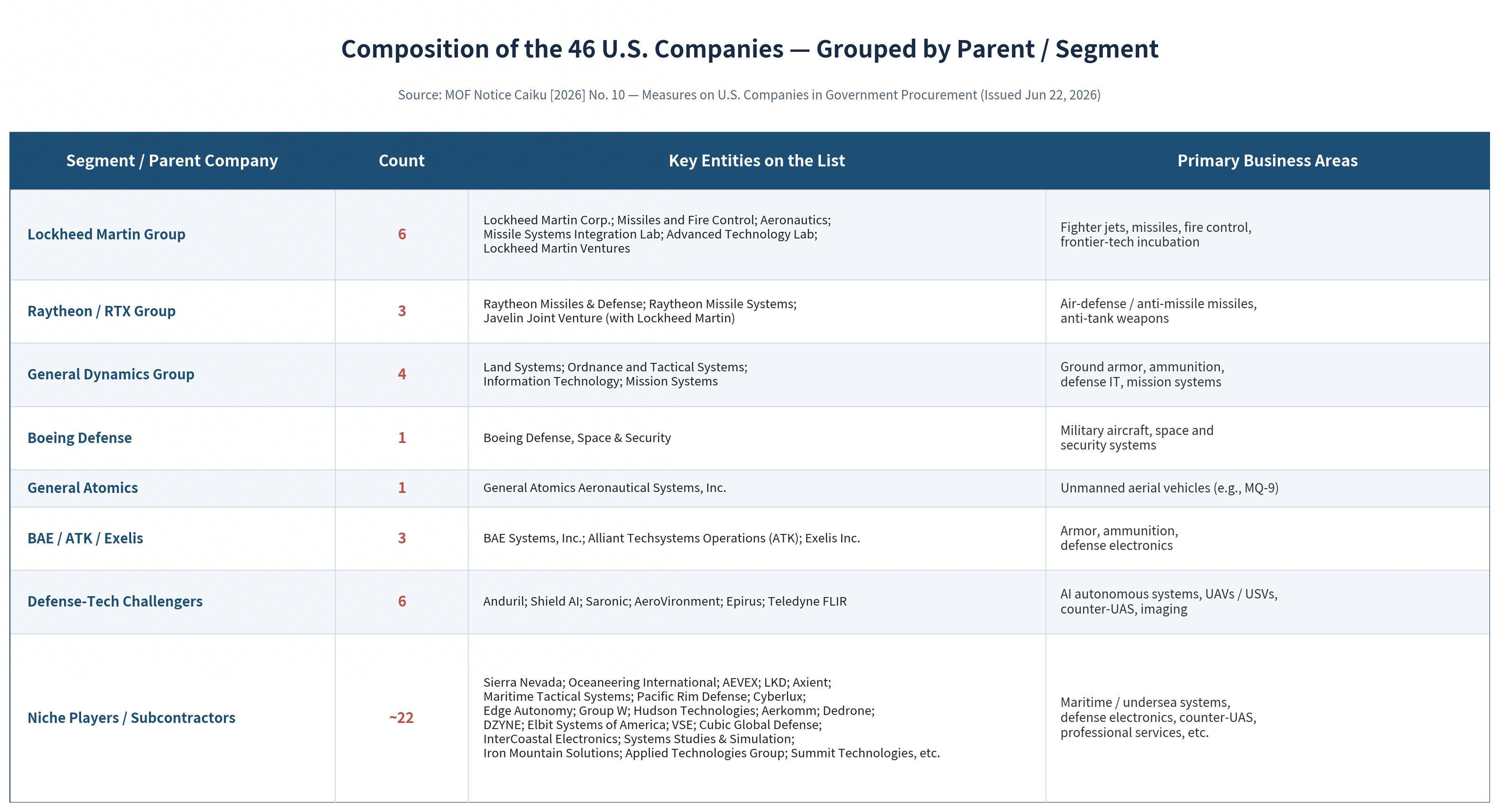
In accordance with relevant laws and regulations, and upon approval, it has been decided to take relevant measures against 46 U.S. companies in government procurement activities. The details are hereby notified as follows:
I. In government procurement activities, procuring entities shall not purchase products manufactured by the 46 U.S. companies listed in the Annex (excluding U.S.-invested enterprises established in China).
II. This Notice shall take effect as of the date of issuance.
Annex: List of 46 U.S. Companies
Ministry of Finance of the People’s Republic of China
Caiku [2026] No. 10
On June 8, the U.S. Department of War updated its Section 1260H list. The updated list includes 17 Chinese companies, among them Alibaba, Baidu, and BYD. The Pentagon also made clear that additional companies could be added in the future. At the same time, the U.S. government emphasized that inclusion on the 1260H list does not automatically trigger sanctions, although it could pave the way for future restrictions under other legal authorities.
The legal basis for the list is Section 1260H of the FY2021 National Defense Authorization Act (NDAA). Originally, the list was designed to identify companies that the U.S. government believes are linked to China’s military and that operate, directly or indirectly, in the United States. It is not the Treasury Department’s SDN list, so it does not automatically freeze assets. It is not the Commerce Department’s Entity List, so it does not automatically block exports. Nor is it the NS-CMIC list, which restricts U.S. investment in certain Chinese companies. For many years, the market largely viewed 1260H as a naming-and-shaming exercise and a reputational risk label.
That changed a bit with Section 805 of the FY2024 NDAA.
Starting on June 30, 2026, the DoW is prohibited from directly entering into or renewing contracts for goods or services with companies on the 1260H list, as well as entities they control. This is the first clear and tangible legal consequence of being listed. In practical terms, companies on the list will be shut out of the Pentagon’s supplier ecosystem.
The restriction is not limited to traditional defense products. It can affect cloud services, software, AI capabilities, data-processing services, robotics, batteries, memory chips, autonomous-driving technologies, and other digital products and services if the ultimate customer is the DoW or if the contract ultimately flows into the DoW procurement system.
The restrictions become even broader one year later. Beginning June 30, 2027, the Pentagon will not only be barred from buying directly from listed companies, but also from procuring their products, components, or services indirectly through prime contractors, subcontractors, or deeper tiers of the supply chain. For large technology companies, the bigger challenge is often not whether they sell directly to the DoD, but whether their technology, components, compute, storage, batteries, or software are embedded in products supplied by others.
The importance of the 1260H list also lies in its spillover effects. Once a company is placed on the list, it effectively enters the U.S. national security system’s watchlist, lowering the political and bureaucratic barriers for future restrictions.
From a commercial perspective, the bigger concern is often overcompliance. Many multinational companies treat a 1260H designation as a red flag. Rather than spending time analyzing whether cooperation remains legally permissible, they often choose the safer route: reduce exposure and look for alternative suppliers. As a result, the practical impact of the list can extend well beyond its formal legal consequences.
So when I saw such a large-scale expansion of the 1260H list, my initial view was that Beijing probably wouldn’t just let this slide. I expected a strong public response, followed by some limited countermeasures. Three reasons:
1/ The scope of the list has expanded significantly. Traditionally, 1260H focused on defence-related SOEs. This time it reaches into cloud services, EVs, biotech, robotics, and drones—all sectors at the core of China’s “new productive forces” strategy. Beijing is likely to see this as an attempt to constrain China’s future technological advantages, which makes it politically difficult to shrug off.
2/ The direct impact is manageable, but it’s not just a reputational issue. NDAA Section 805 has linked the list to DoD procurement restrictions, and the risk of over-compliance by international business partners could amplify the indirect effects.
3/ This is arguably the first major and politically significant escalation of U.S. restrictions on China since the Busan summit. It also lays the groundwork for tougher measures down the road, including investment restrictions and supply-chain exclusions. Beijing may feel that failing to respond would only encourage more of the same. At the same time, a calibrated response would not necessarily derail broader stability in the relationship.
This interpretation was reinforced by the subsequent responses from both MOFCOM and the Ministry of Foreign Affairs. Both signaled that China would retaliate, but MOFCOM's statement was notably sharper in tone and, by recent standards, somewhat unusual.
Question: On June 8 (U.S. time), the Department of Defense added several Chinese companies to its “Chinese Military Companies” list. What is MOFCOM’s response?
Answer: We have noted the development. China is strongly dissatisfied with and firmly opposed to this action.
The U.S. has disregarded the consensus reached by the two heads of state in Beijing, ignored the broader interests of China-U.S. economic and trade relations, continuously overstretched the concept of national security, and abused state power to suppress Chinese companies without justification. These actions seriously undermine the international economic and trade order, disrupt the stability of global industrial and supply chains, and harm the legitimate rights and interests of Chinese enterprises.
China urges the United States to immediately stop its wrongful practices, revoke the relevant measures, and return to the right path of building a constructive and strategically stable China-U.S. relationship. The U.S. should provide Chinese companies with fair, equitable, and non-discriminatory treatment.
Otherwise, China will take firm and forceful countermeasures, and the consequences and responsibility arising from them will rest entirely with the U.S. side.
Question: The United States has added a number of Chinese technology companies, including Alibaba, Tencent, and BYD, to its list of companies allegedly supporting China’s military. What is China’s response?
Lin Jian: China has consistently and firmly opposed the U.S. practice of overstretching the concept of national security, creating various discriminatory lists, and unjustifiably suppressing Chinese companies.
We urge the United States to correct its mistakes and stop its unreasonable actions against Chinese enterprises.
China will take necessary measures to firmly safeguard the legitimate rights and interests of Chinese companies.
But at that time, I still thought the odds of such a response were probably only around 30%. A 70% chance that Beijing limits itself to criticism and does not retaliate. Several reasons:
Historically, even when those high-profile companies like Tencent and CATL were added to the 1260H list last year, Beijing’s reaction amounted to strong criticism and promises to defend the rights of Chinese companies, but no visible follow-up retaliation ever materialised.
This designation is not particularly serious, as we explained above. Since the Busan understanding, Washington has already taken several steps that could be seen as changing the status quo. The FCC has kept up pressure on Chinese firms, the Treasury has occasionally added companies to the SDN list, and Beijing has largely chosen not to respond.
In addition, in some of these sectors where China believes it has a technological edge, Beijing may not mind a degree of decoupling from the U.S. There are a couple of recent examples that may point in that direction.
But Beijing retaliated anyway, even though the response was largely symbolic.
The targets remain concentrated in the defense and rare-earth sectors, many of which have already been sanctioned previously. Beijing did not expand the measures to broader categories of U.S. companies. At the same time, the Ministry of Finance’s government procurement restrictions were carefully limited to U.S.-origin products from 46 American firms, explicitly excluding the products of U.S.-invested companies operating and manufacturing in China. In other words, products made in China by those firms can still participate in government procurement.
On the specific measures:
Export-control restrictions on 10 entities
Most of the newly listed entities are defense-oriented contractors whose business is already heavily tied to Pentagon programs and which generally do little or no business with China. The main impact falls on their supply chains, particularly where rare earth magnets, gallium, germanium, or semiconductor-related inputs are involved. However, this is not a new vulnerability.
The most notable additions are MP Materials and USA Rare Earth. In practice, obtaining Chinese heavy rare earth feedstock or separation technology was already highly unlikely for these companies, so the practical impact may be limited even if the political signal is significant.
Government procurement restrictions on 46 U.S. firms
The Ministry of Finance’s decision to bar 46 U.S. companies from government procurement is more noteworthy. China used a similar tool against EU medical device firms in 2025, but this is the first time it has been applied to American companies.
The list covers a broad cross-section of the U.S. defense industrial base. However, because the United States has maintained a comprehensive arms embargo on China since 1989, most of these companies were never realistically selling products to Chinese government agencies or the PLA in the first place. A few firms with commercial business lines, such as Oceaneering or Teledyne/FLIR, have some exposure to China, but even there government procurement represents a relatively small share.
As a result, the direct economic impact is limited. The more important message is one of reciprocity: if the U.S. government prohibits the Pentagon and its contractors from purchasing products from designated Chinese companies under the 1260H framework, China can likewise prohibit its own government agencies from purchasing products from designated U.S. companies.
One thing that is notable is that most of these companies are somewhat related to Taiwan or US arms sales to Taiwan.
A commentary published by China’s Global Times argued that many of the targeted companies have long been involved in U.S.-Taiwan defense cooperation. Citing Taiwan’s Central News Agency, it noted that in September 2024, more than 20 U.S. drone, counter-drone, and unmanned maritime systems companies visited Taiwan as part of an AIT-organized trade delegation, including Jaia Robotics. The commentary also highlighted that L3Harris Maritime Services and Red Cat participated in the Taipei Aerospace & Defence Technology Exhibition last year.
The commentary further quoted military analyst Zhang Junshe, who noted that
China had already sanctioned L3Harris Maritime Services, Teal Drones, and Red Cat through Foreign Ministry measures in December 2025. The fact that these companies are now being targeted again by MOFCOM reflects Beijing’s view that they have played a particularly significant role in supporting Taiwan-related military activities. The combined measures are intended to cut off trade, technology cooperation, and technology transfers involving dual-use items, thereby reducing external support for pro-independence forces in Taiwan.
Regarding MP Materials and USA Rare Earth, the commentary pointed to Bloomberg reporting that Washington is actively building alternative critical minerals supply chains to support advanced manufacturing and defense industries. It argued that the latest Chinese measures are aimed directly at key nodes in that supply chain. The commentary also noted growing U.S.-Taiwan cooperation on critical minerals, including commitments made during the sixth U.S.-Taiwan Economic Prosperity Partnership Dialogue earlier this year.
Zhang Junshe argued that:
Rare earths are essential inputs for military platforms such as fighter aircraft, warships, missiles, and military drones. Since the United States uses rare earths to manufacture weapons that are subsequently sold to Taiwan, placing MP Materials and USA Rare Earth under export-control restrictions is, in Beijing’s view, a way to weaken the material foundation of future U.S. arms sales to Taiwan.
Li Haidong, a professor at the China Foreign Affairs University, was quoted as saying that
China would seek to “maximally weaken and strike” U.S. companies that play a major role in arming Taiwan.
My main takeaways are:
First, Beijing appears to have a fairly accurate understanding of what the 1260H list actually is and didn’t overreact. Today’s measures were likely not aimed solely at the latest 1260H designations. They appear to be a broader response that also reflects accumulated frustration over recent SDN listings, FCC restrictions, and other U.S. actions.
Second, that restraint should not be mistaken for passivity. China’s longstanding approach of “fighting when necessary in order to preserve stability” remains intact. If the U.S. continues to roll out additional restrictive measures, Beijing is likely to respond in kind.
Third, the remarkable addition of government procurement restrictions seems to send a clear warning to Washington: many non-defence U.S. companies operating in China still have commercial interests tied to government procurement, and those interests could become targets in future rounds of escalation.
The word "calibrated" is doing the real work here — Beijing's response is precise enough to signal capability without triggering the full escalation cycle. Splitting it across two ministries (MOFCOM export controls on 10, MOF procurement exclusion on 46) is itself the message: graduated instruments, each scalable independently, none of them a door slammed shut. That's the asymmetry that makes Chinese economic statecraft hard to counter — it's built to leave room to climb or de-escalate at every rung, whereas designation regimes tend to be binary. Worth watching whether the procurement exclusions bite harder than the export-control additions, since government-procurement leverage is the quieter, more durable of the two.


The word "calibrated" is doing the real work here — Beijing's response is precise enough to signal capability without triggering the full escalation cycle. Splitting it across two ministries (MOFCOM export controls on 10, MOF procurement exclusion on 46) is itself the message: graduated instruments, each scalable independently, none of them a door slammed shut. That's the asymmetry that makes Chinese economic statecraft hard to counter — it's built to leave room to climb or de-escalate at every rung, whereas designation regimes tend to be binary. Worth watching whether the procurement exclusions bite harder than the export-control additions, since government-procurement leverage is the quieter, more durable of the two.