

On June 24, 2026, China’s Ministry of Commerce issued Announcement No. 26, a directive aimed at “further improving” the reporting and handling of violations involving strategic minerals and dual-use items.
This new mechanism, set to take effect on July 1, 2026, establishes formal channels—including a dedicated hotline (010-12369) and an online portal—for individuals to report unauthorized exports of critical resources. A MOFCOM spokesperson framed the move as an “international common practice,” noting that many countries use public reporting to monitor export-control compliance.
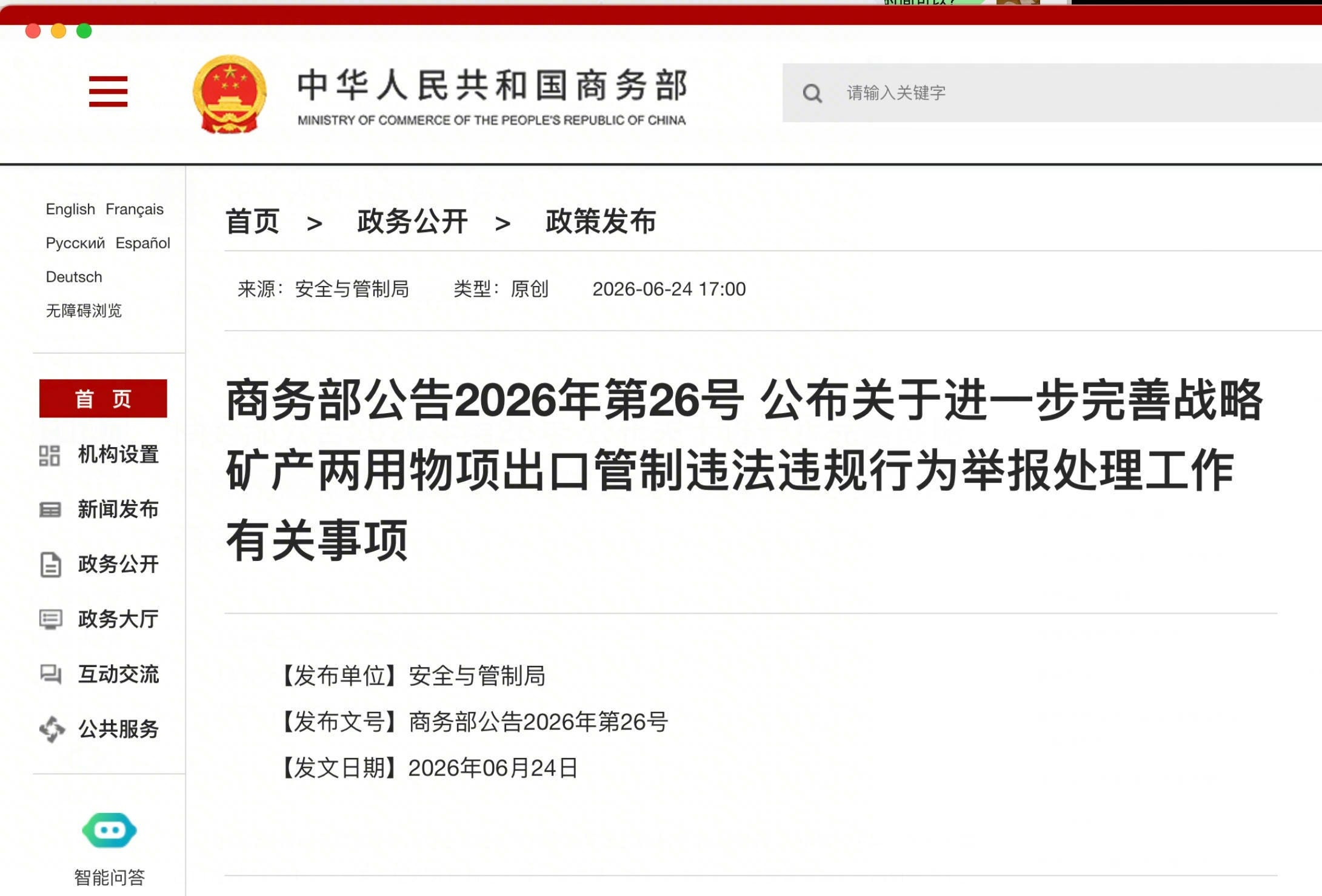
MOFCOM Announcement No. 26 of 2026
Issued by: Bureau of Industrial Security and Export Control
Date: June 24, 2026
To strengthen public oversight and combat violations of export controls on strategic mineral-related dual-use items, and in accordance with the Export Control Law of the People’s Republic of China, the Foreign Trade Law of the People’s Republic of China, and other relevant laws and regulations, the Ministry of Commerce (MOFCOM) has decided to further improve the reporting and handling mechanism for violations related to strategic mineral export controls.
The following matters are hereby announced:
I. Reportable Violations
Any organization or individual has the right to report suspected violations involving the export of strategic mineral-related dual-use items, including:
Exporting controlled strategic mineral-related dual-use items without a license;
Exporting beyond the scope, conditions, or validity period specified in an export license;
Exporting items whose export is prohibited;
Circumventing licensing requirements through modification, disassembly, or export as parts and components;
Circumventing export controls through third-country transshipment;
Illegally transferring controlled technologies through trade, licensing, investment, exchanges, gifts, exhibitions, testing, assistance, training, joint R&D, employment, consulting, or other means;
Providing services such as agency, freight forwarding, logistics, customs declaration, e-commerce platforms, or financial services while knowingly facilitating export control violations;
Instructing or assisting exporters, importers, or end users in evading export controls;
Conducting transactions with importers or end users listed on a control list;
Failing to apply for a license when exporters know or should know that goods, technologies, or services not specifically listed may pose risks described under Article 12 of the Export Control Law;
Domestic importers or end users violating commitments made to MOFCOM;
Accepting or committing to foreign government requests for inspections, visits, or on-site verification related to strategic mineral export controls without authorization;
Other violations of laws and regulations governing export controls on strategic mineral-related dual-use items.
II. Reporting Channels
Reports may be submitted through:
The online reporting platform on the website of MOFCOM’s Bureau of Industrial Security and Export Control (https://aqygzj.mofcom.gov.cn);
The reporting hotline: +86-10-12369 (available on official working days from 8:30–11:30 and 14:00–17:00).
III. Reporting Requirements
Reporters are responsible for the accuracy of the information provided. Reports should generally include:
Information about the reporter;
Contact information;
Information about the reported party;
Details of the suspected violation;
Whether the same matter has been reported to another authority;
Any other information the reporter believes relevant.
Reports should be submitted in Chinese.
IV. Circumstances Under Which Reports Will Not Be Accepted
Reports will generally not be accepted if:
The matter does not fall within the scope described above;
Key information is missing and remains incomplete after MOFCOM requests supplementation;
The matter has already been fully handled and is being repeatedly reported based on the same facts;
Other circumstances where acceptance is deemed inappropriate.
V. Feedback and Rewards
For reports submitted under real names, MOFCOM will provide feedback on acceptance and handling status through appropriate channels. Individuals whose reports are verified may receive rewards in accordance with relevant regulations.
VI. Malicious Reporting
MOFCOM, together with relevant authorities, will carefully review suspected malicious reports and handle them in accordance with the law.
VII. Voluntary Disclosure
Exporters or other entities that discover they may have violated export control regulations are encouraged to voluntarily report the matter to MOFCOM. Voluntary disclosure may be considered a mitigating factor when determining penalties.
VIII. Confidentiality
Government agencies, organizations, and individuals involved in handling reports shall keep confidential any state secrets, commercial secrets, or personal information obtained during the process.
IX. Technology Export Violations
Reports involving suspected violations of strategic mineral-related technology export controls under the Regulations of the People’s Republic of China on the Administration of Technology Import and Export shall be handled with reference to this announcement.
This announcement shall take effect on July 1, 2026.
Ministry of Commerce of the People’s Republic of China
June 24, 2026
In a June 24 Q&A, the spokesperson grounded the policy in Article 31 of China’s Export Control Law—which gives “any organization or individual” the right to report suspected violations—and argued that borrowing from “the experience of various countries” would help keep strategic minerals from being “used for illegal purposes” while protecting the legitimate rights of compliant traders.
Question: We have noticed that the Ministry of Commerce has issued an announcement further improving the reporting and handling mechanism for violations involving export controls on strategic mineral-related dual-use items. What is the rationale behind this move?
Answer: Article 31 of the Export Control Law of the People’s Republic of China provides that any organization or individual has the right to report suspected violations of export control regulations to the relevant state export control authorities. Strengthening the reporting and handling of violations involving strategic mineral-related dual-use items, and enhancing enforcement capabilities, is a basic requirement for improving China’s export control system and a normal measure to safeguard national security and interests.
At the same time, using reporting mechanisms to support enforcement of export control laws is a common international practice. Many countries have similar systems in place. Drawing on international experience and improving China’s reporting framework for strategic mineral-related dual-use items will help prevent such items from being used for illicit purposes, better contribute to global peace and security, and demonstrate China’s responsibilities as a major country.
In the past, we have already accumulated practical experience in handling reports of potential violations. It is therefore necessary to further clarify reporting channels, reporting requirements, and related procedures in order to improve the handling of leads and investigations.
Going forward, the relevant authorities will process reports in accordance with laws and regulations while safeguarding the legitimate rights and interests of compliant trading companies.
For the last few years, Washington has been aggressively building a similar apparatus, transforming whistleblowers into a front-line force for enforcing semiconductor export controls against China. People are witnessing the privatization of export-control enforcement. Whether you are a disgruntled employee in a Silicon Valley fab or a logistics coordinator in a Shenzhen warehouse, you are now a potential enforcement agent in a global rivalry.
Washington’s turn toward the informant economy was born out of a realization: traditional auditing is too slow for the speed of AI and advanced chips. The legislative foundation began to shift in late 2022 with the Anti-Money Laundering (AML) Whistleblower Improvement Act, which expanded reward programs to cover trade and economic sanctions violations. For the first time, tipsters could claim between 10% and 30% of collected fines that exceed $1 million.
However, a significant legal gap remained. While sanctions were covered, the Export Control Reform Act (ECRA)—the primary tool used to block the flow of semiconductors to China—lacked a dedicated whistleblower bounty.
The “Stop Stealing our Chips Act”, introduced by a bipartisan pair, Senators Mike Rounds (R-SD) and Mark Warner (D-VA), aims to close this loophole by creating a formal whistleblower incentive program within BIS. The Senate passed the bill unanimously on May 22, 2026, though as of late June, it has yet to be signed into law following its advancement in the House. If finalized, it would mirror the AML rewards, offering 10–30% of fines to those who expose semiconductor smuggling.
While Congress deliberates, the executive branch has already moved. In April 2023, BIS issued guidance incentivizing companies to report their competitors’ violations in exchange for “mitigation credit” on their own future liabilities. The Department of Justice followed suit with a Corporate Whistleblower Awards Pilot Program in August 2024, which was expanded in May 2025 to explicitly cover sanctions and trade fraud.
The results are already showing up in court. In December 2025, the DOJ dismantled “Operation Gatekeeper,” a smuggling ring that reportedly funneled $160 million worth of export-controlled Nvidia H100 and H200 GPUs to China. Months later, in March 2026, federal prosecutors charged a co-founder of Super Micro Computer for allegedly conspiring to divert $2.5 billion in Nvidia AI servers to the mainland. These cases are increasingly built on “implementation intelligence”—the kind of granular detail only an insider can provide.
In the similar way, China has spent the last two years constructing a parallel enforcement apparatus to police its own export controls on gallium, germanium, antimony, and rare earth elements.
The June 2026 MOFCOM announcement is the capstone of this effort. It builds on the 2020 Export Control Law, which already mandated whistleblower confidentiality, and the 2024 Dual-Use Items Export Control Regulations, which went into effect on December 1, 2024. These new rules even impose mandatory reporting obligations on service providers, like freight forwarders and banks, who “discover suspected violations” during their business operations.
In May 2025, China launched a multi-agency “Special Action to Crack Down on Strategic Mineral Smuggling,” involving the police, customs, and state security. The crackdown has already targeted high-profile figures. Lan Tianli, the Governor of Guangxi, was placed under investigation in May 2025; while official statements used broad language about “discipline violations,” contemporary reports linked the case to a family-run operation that allegedly misdirected mining rights for illicit export.
Beijing is also increasingly willing to leverage “competitive reporting.” In July 2025, Chinese media reported that a tip from the U.S. company Alpha Materials helped customs intercept a 300-ton shipment of disguised rare earth minerals, valued at $80 million, that was bound for the United States. Later that year, Shenzhen port officials intercepted 25 tons of NdFeB magnetic powder—a critical material for the F-35 fighter—that had been creatively disguised as “tile adhesive”. By formalizing the rewards for such “real-name” reporting in the June 2026 announcement, MOFCOM is signaling that it wants more of these insider-driven busts.
According to Lianhe Zaobao—citing Japan’s Asahi Shimbun and Kyodo News—Chinese authorities detained two Japanese nationals in the northeastern city of Dalian, Liaoning Province, in May 2026 on suspicion of “smuggling goods prohibited from import or export by the state”. One of them, reportedly a Japanese male employee of a large local Japanese-funded electronics company, was accused of trying to ship products made with export-controlled rare-earth elements out of China. Japanese Chief Cabinet Secretary Minoru Kihara disclosed the cases on June 24, 2026, saying the two had been detained on May 18 and May 25, with Chinese customs notifying Japan’s diplomatic missions the day after each detention.
The privatization of export controls changes the risk calculus for every company operating in the U.S.-China corridor. In the past, compliance was a game played against the regulator; today, it is a game played against your own internal data and your own workforce.