

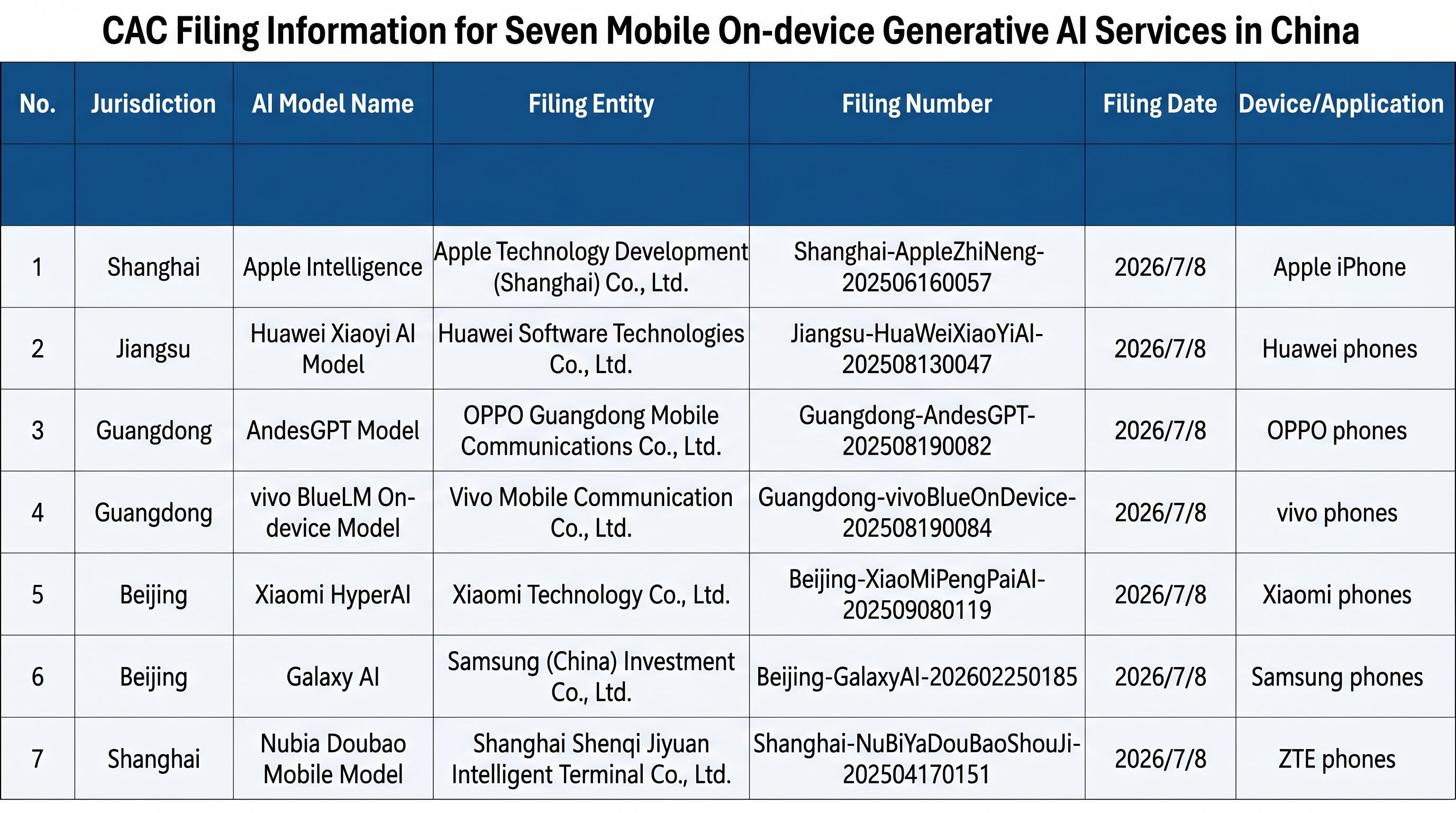
On 8 July 2026, Apple China completed the filing procedure required by the Cyberspace Administration of China (CAC) for its Apple Intelligence large language model. On 15 July, the CAC's official "Cyberspace China" WeChat account publicly announced the latest batch of approved generative AI services, listing Apple Intelligence alongside AI services from Huawei, OPPO, vivo, Xiaomi, Samsung, and Nubia as one of seven on-device generative AI services approved for smartphone deployment.
Apple’s Efforts and the Regulatory Background
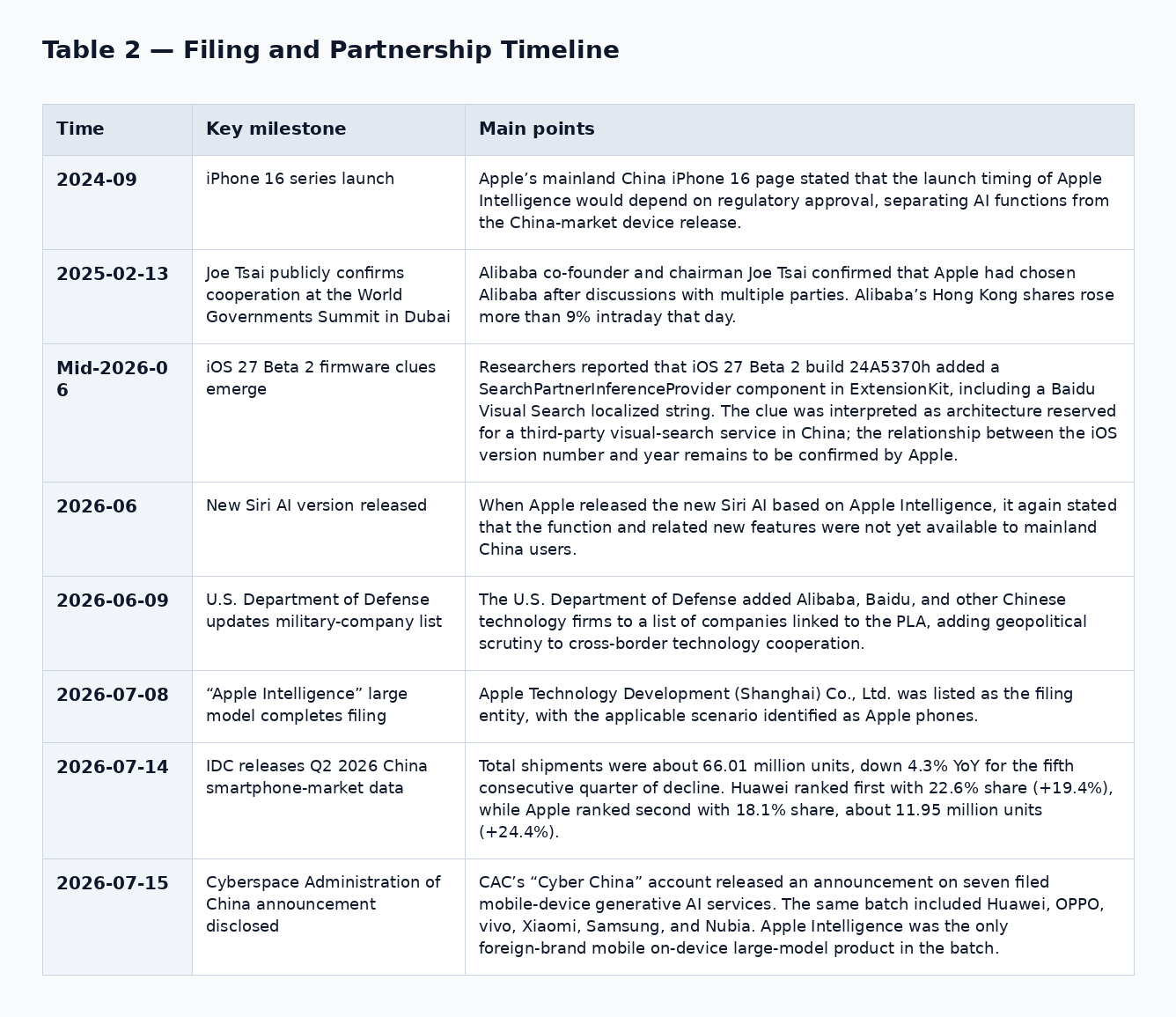
Since the launch of the iPhone 16 in September 2024, Apple had consistently indicated that Apple Intelligence would be available in mainland China “subject to regulatory approval.” It ultimately took nearly 22 months for Apple to complete China’s regulatory filing process. During this period, Apple navigated multiple regulatory procedures established under China’s generative AI governance framework, including model filing requirements, submission through the local Cyberspace Administration, public disclosure of approved filings, and subsequent security assessment procedures.
China’s Interim Measures for the Administration of Generative Artificial Intelligence Services were jointly issued by seven government agencies—the Cyberspace Administration of China (CAC), the National Development and Reform Commission (NDRC), the Ministry of Education (MOE), the Ministry of Science and Technology (MOST), the Ministry of Industry and Information Technology (MIIT), the Ministry of Public Security (MPS), and the National Radio and Television Administration (NRTA)—and entered into force on 15 August 2023.
The Measures establish a mandatory filing regime for providers of generative AI services that possess “public opinion attributes or the capacity for social mobilization.” In practice, service providers submit filing applications through the CAC office in their local jurisdiction. Local CAC offices publish approved filings in a timely manner, while the national CAC periodically consolidates and updates the nationwide list of approved services on its official website.
With respect to foreign companies, industry practitioners generally understand the current framework to require overseas AI providers serving Chinese users to conduct filings through an onshore legal entity under the same regulatory standards applicable to domestic providers. In addition, applicants are generally expected to provide documentation relating to cross-border data security assessments as well as compliance documentation concerning their overseas parent companies. However, the precise implementation requirements continue to depend on the specific characteristics of each project, and some aspects of the regulatory framework remain subject to case-by-case interpretation.
The major milestones between the launch of the iPhone 16 and Apple’s successful regulatory filing can be reconstructed chronologically as follows.
Regulatory Approval Is Only the First Step
From a regulatory perspective, obtaining the filing approval should be viewed primarily as an entry ticket rather than authorization for immediate deployment. Several implementation steps remain before Apple Intelligence can be officially activated on mainland Chinese devices. According to media reports, Apple must still complete the required security assessments, feature localization and adaptation, and potentially additional operating system updates before the service becomes available to Chinese users.[18]
According to Alibaba, Qwen will be integrated directly into Apple Intelligence as the underlying AI capability for users of iOS, iPadOS, macOS, and visionOS in mainland China, enabling a consistent AI experience across Apple’s entire ecosystem—including smartphones, tablets, desktop computing, and spatial computing devices. Alibaba further stated that users will be able to access Qwen’s capabilities—including text understanding, image understanding, and content generation—directly within Apple’s operating system without switching between applications. In other words, Qwen is expected to function as part of Apple’s system-level AI layer, rather than as a standalone application.
Why Apple Chose Alibaba
Apple’s decision to prioritize Alibaba over DeepSeek, Baidu, or other Chinese AI providers likely reflects multiple strategic considerations.
From a data perspective, Alibaba possesses significantly richer consumer datasets than most competitors, particularly in areas such as e-commerce behavior, digital payments, and consumer spending patterns. Training on these datasets is widely believed to improve a model’s ability to provide highly localized and personalized AI services for Chinese users.
From an engineering and infrastructure perspective, Alibaba Cloud’s localized cloud infrastructure in mainland China aligns well with the architectural philosophy of Apple’s Private Cloud Compute (PCC). Industry sources have also suggested that Qwen 3 has undergone engineering optimization for Apple’s MLX framework. Given Apple’s exceptionally high standards for model quality, reliability, and privacy protection, Alibaba may have been one of the few Chinese partners capable of satisfying Apple’s technical and operational requirements.
Alibaba as the Core LLM Provider, Baidu as the Vision Partner
Baidu appears to occupy a more specialized role within Apple’s China AI ecosystem. Rather than serving as the primary foundation model provider, Baidu is expected to supply AI capabilities for computer vision-related functions, including camera recognition and visual search.
Alibaba’s Qwen, by contrast, is expected to provide the core large language model capabilities, including natural language understanding, reasoning, and content filtering.
Why Apple Adopted a Multi-Partner Strategy
Apple’s decision to adopt a dual-supplier model, rather than relying on a single Chinese AI provider, likely reflects several strategic objectives.
First, it enables what might be described as functional specialization. Apple can separate AI capabilities into distinct layers—including perception, cognition, and compliance—and assign each layer to different domestic partners. This approach helps satisfy Chinese regulatory requirements while preserving supply chain flexibility and redundancy.
Second, Apple’s collaboration with Baidu reportedly encountered difficulties during 2024–2025, largely because Baidu’s ERNIE Bot was initially considered unable to meet Apple’s standards for model performance and privacy protection. Apple subsequently shifted toward a structure in which Alibaba became the primary LLM partner, while Baidu continued to provide specialized vision and search capabilities.
More importantly, embedding a multi-vendor switching mechanism into the system firmware allows Apple to dynamically select service providers by geography and by function. Such an architecture not only increases operational flexibility but also reduces commercial dependence on any single AI supplier.
Implications for Apple
The successful completion of the filing process is clearly a positive development for Apple.
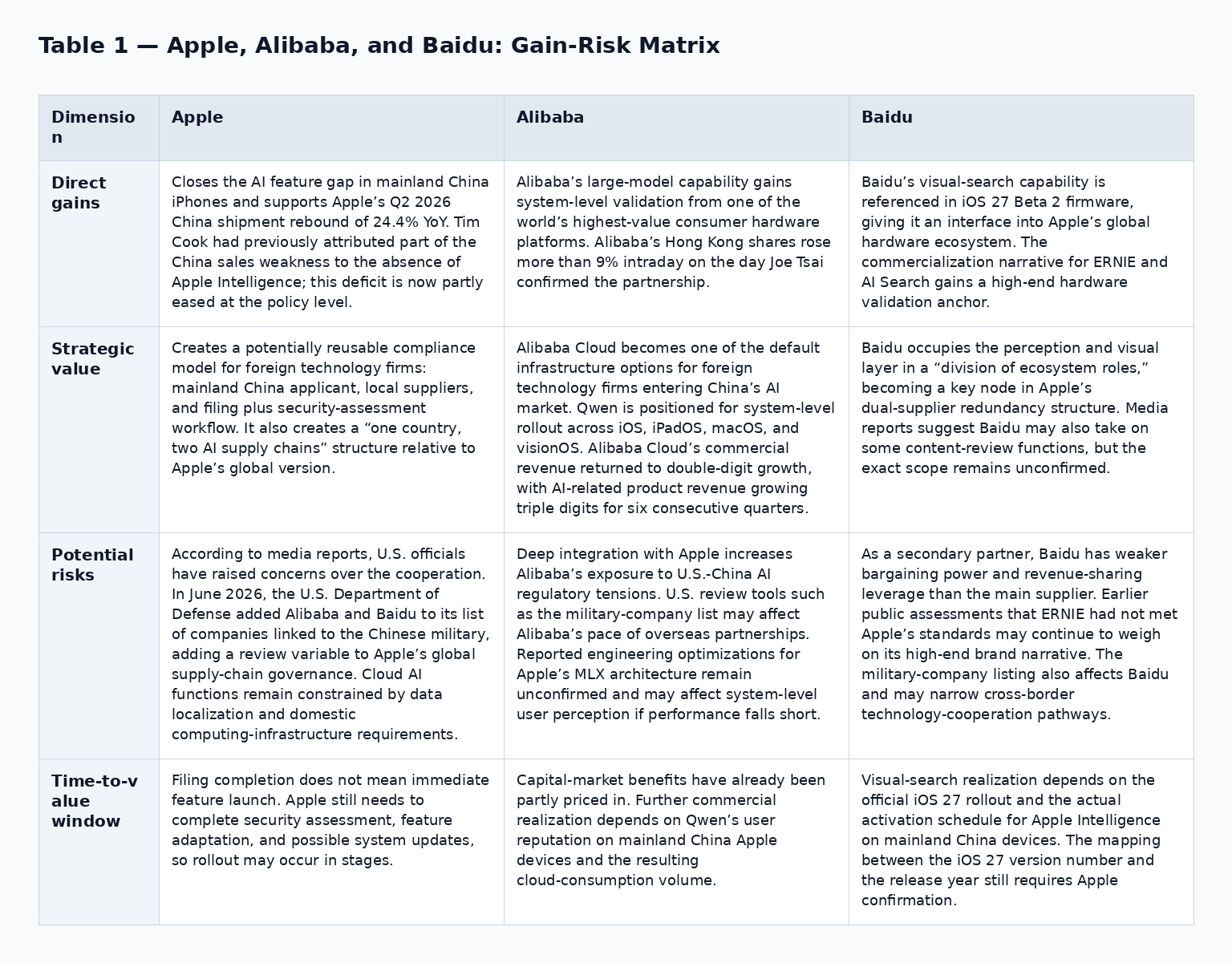
CEO Tim Cook previously attributed part of Apple’s declining sales performance in China to the absence of Apple Intelligence. Regulatory approval now removes one of the major policy obstacles preventing Apple from closing the AI feature gap between Chinese and overseas iPhone models. This should reinforce Apple’s already strong shipment recovery in China, where iPhone shipments reportedly increased 24.4% year-over-year in the second quarter of 2026.
Nevertheless, uncertainties remain.
In June 2026, the U.S. Department of Defense added both Alibaba and Baidu to its Section 1260H Chinese Military Companies List, potentially introducing new variables into Apple’s global supply chain governance. Meanwhile, cloud-based AI functions remain constrained by China’s data localization requirements and the need to rely on domestic computing infrastructure, leaving the ultimate implementation pathway uncertain.
Moreover, regulatory filing does not automatically mean immediate commercial availability. Apple Intelligence must still complete security reviews, engineering adaptation, and possible operating system updates before deployment, and different features may ultimately be rolled out in phases.
Implications for Alibaba and Baidu
For Alibaba, the partnership represents a significant endorsement of its foundation model capabilities by the world’s most valuable consumer hardware ecosystem. It positions Alibaba Cloud as one of the default infrastructure providers through which multinational technology companies may access China’s AI market, while enabling Qwen to become deeply integrated into the system layer across iOS, iPadOS, macOS, and visionOS.
However, U.S. sanctions remain an important source of uncertainty. In addition, much of the expected commercial value from the partnership has arguably already been reflected in capital markets. Future monetization will depend largely on user adoption of Qwen-powered Apple Intelligence on Chinese devices and the resulting growth in cloud inference demand.
Baidu also benefits, although to a lesser extent. Its visual search capabilities have reportedly been incorporated into the iOS 27 Beta 2 firmware, giving Baidu an entry point into Apple’s global hardware ecosystem. This also strengthens the commercialization narrative surrounding ERNIE and Baidu AI Search by demonstrating adoption within a premium consumer hardware platform.
A Potential Template for Foreign AI Companies Entering China
Based on the currently available information, Apple’s implementation strategy suggests that on-device AI capabilities are likely to be deployed first, as they rely primarily on local computation. By contrast, cloud-based AI functions face greater uncertainty because they must comply with China’s data localization rules and operate on domestic computing infrastructure.
It is also worth noting that Samsung’s Galaxy AI was included alongside Apple Intelligence in the same batch of seven smartphone-based generative AI services approved by the CAC on 15 July 2026.
Unlike Apple’s filing, which centers on Apple Intelligence as an integrated AI platform, Samsung’s filing covers a portfolio of on-device generative AI services for mainland Chinese users rather than a single foundation model. The filing was submitted in Beijing by Samsung (China) Investment Co., Ltd.
From a technical perspective, Galaxy AI in China also adopts a multi-partner architecture. Baidu’s ERNIE provides core natural language generation capabilities, including features such as real-time call translation and text summarization; Meitu’s MiracleVision powers AI-enabled camera and image generation functions; and ByteDance’s Doubao model supports selected AI portrait and image-generation features. These third-party capabilities are complemented by Samsung’s own on-device technologies, including Samsung Knox security and local on-device inference.
More broadly, Apple and Samsung’s approach may point to a reusable compliance model for foreign AI companies or services seeking to operate in China: a domestic Chinese legal entity serves as the regulatory applicant; localised cloud infrastructure hosts cloud inference; and domestic technology partners assume a substantial share of regulatory and compliance responsibilities. Such a framework could become an increasingly important reference model for multinational AI providers entering the Chinese market.
The multi-vendor switching architecture is the detail that deserves the most attention downstream. Apple built a system where Qwen handles language, Baidu handles vision, and the firmware can swap providers by geography and function. That's not a partnership. That's a procurement framework designed to ensure no single Chinese AI company ever has leverage over Apple's China stack. The same architecture that satisfies the CAC's localisation requirements also prevents any domestic partner from becoming indispensable.
The Section 1260H listing of both Alibaba and Baidu on the US military companies list while Apple simultaneously deepens its dependence on both for the world's largest smartphone market is the kind of contradiction that keeps export control lawyers employed for decades.
Interesting details about Apple Intelligence’s China regulatory approval by CAC (Cyberspace Administration of China), as announced by CAC official WeChat on July 15, 2026.
Also discusses Samsung’s Galaxy AI China regulatory approval
- interesting multi-LLM-vendor approach by both Apple China & Samsung China.
Worth a read!