

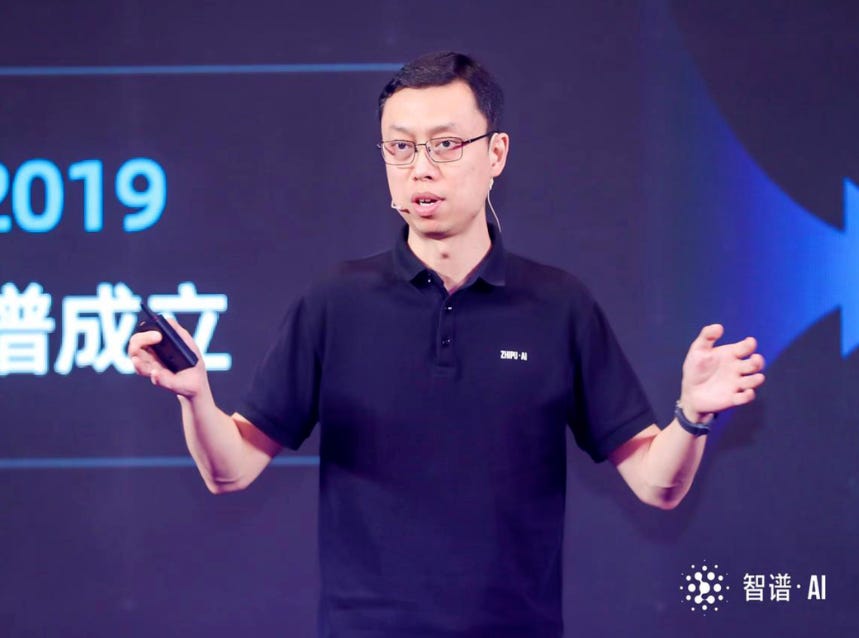
Recently, Xueqiu’s professional investment interview series, Xueqiu founder and chairman Fang Sanwen sat down with Zhang Peng, CEO of Zhipu, for a wide-ranging conversation on the evolution of AI, the boundaries of AI applications, and Zhipu’s business model.
When asked which of the three factors—compute, data, or algorithms—is the biggest bottleneck for AI development, and which breakthrough could drive the next wave of progress, he said the answer changes over time.
In the early days, many people believed algorithms were the key, and that advances in algorithms could take AI directly toward AGI. Later, as model sizes and parameter counts expanded dramatically, people began to worry that the amount of usable data on the internet might be insufficient, raising concerns about “running out of data” and hitting a ceiling in pre-training.
As researchers started exploring ways to address the data problem, it gradually became more manageable. At that point, the focus shifted to compute, with concerns that there might not be enough computational power to sustain continued scaling. But with technological progress and companies like NVIDIA ramping up production aggressively, access to compute has also improved.
Now the conversation is shifting again. Some people argue that the algorithms themselves may be the limiting factor—that current methods may be inefficient, struggle with issues such as catastrophic forgetting, and may not scale indefinitely. Many researchers even predict that the Transformer architecture itself could eventually be replaced or fundamentally redesigned.
He argues that AGI does not currently have a single authoritative or clearly defined meaning. Compared with “AI,” the conceptual boundaries of AGI remain ambiguous. Both academia and industry hold different interpretations of its scope and implications. As a result, any discussion about AGI inevitably begins with the question of how it should be defined.
In his view, AGI is likely achievable as long as the definition is reasonable. If AGI is defined in a way that is not overly grand or unrealistic, but instead operational and concrete, then achieving it becomes more a matter of time rather than principle. From the day it was founded, Zhipu has set AGI as its long-term goal and has developed its own internal framework for defining it.
AGI is often defined using behavioral criteria, similar to how the Turing Test defines intelligence through observable behavior. One common view is that when AI reaches the average level of human performance across a wide range of capabilities, it can be considered AGI. Once such a behavioral definition is adopted, it becomes possible to work backward to determine the technical roadmap—gradually improving models so that their performance across different tasks approaches or matches human-level ability.
When asked whether the world’s main general-purpose large model players — now roughly four or five, mostly in China and the United States, with Europe’s Mistral as another example — might eventually narrow down to just one, Zhang Peng said his instinct was that this would not happen.
In his view, technological development needs diversity, especially in the early and middle stages, when there are still many possible paths for innovation and many different research directions. At that stage, companies will naturally differentiate from one another, and each can still find room to survive. On top of that, the market itself is very large and still expanding rapidly, so there is enough space for multiple players and no reason for the field to converge too quickly.
He argued that in the early and middle phases, the ecosystem is likely to remain diverse. Even if one company gains an advantage, that does not mean it will automatically take the whole market. A true winner-takes-all outcome is more likely only once the technology becomes relatively stable and the pace of innovation slows, at which point Matthew effects become stronger. At the current stage, however, he does not think one company dominating everything is likely, nor does he see any clear sign that the industry is heading in that direction.
Transcript of the conversation is below:
The public’s questions about AI still have not gone beyond Turing’s nine objections
Fang Sanwen: What is AI?
Zhang Peng: AI is an abbreviation for Artificial Intelligence. In the most straightforward sense, it means using technological methods — whether computers or other means — to simulate human intelligence and ultimately serve people.
Fang Sanwen: In his 1950 paper Computing Machinery and Intelligence, Turing proposed the concept of intelligence, and later the Dartmouth conference directly defined artificial intelligence. What is the relationship between the AI we talk about today and Turing’s concept of intelligence, or the AI defined in 1956?
Zhang Peng: If we describe it in terms of logic or mathematics, intelligence is the bigger circle, and artificial intelligence is one part of it — specifically, our attempt to simulate human intelligence. So when we talk about AI or artificial intelligence today, we are still basically referring to the concept proposed at the 1956 Dartmouth conference. That said, as time has passed and technology and markets have changed, the meaning of AI has continued to evolve. Today’s AI covers a broader range of things than it did back then, but the core objective has not changed.
Fang Sanwen: Are large models and AI the same thing?
Zhang Peng: Large models are just one of the technical approaches we use to realize artificial intelligence.
Fang Sanwen: From the 1950s to today, what major milestones has AI gone through?
Zhang Peng: It has been more than 70 years, though not yet 80. Over those decades, AI development has not been smooth at all. Most people agree there have been three waves of AI, or strictly speaking, you could say we are now in the fourth. Why has it risen and fallen? I think that is historically inevitable. Nothing develops in a perfectly upward curve forever. Along the way you run into all kinds of challenges and difficulties, and when combined with the broader social and economic context of the time, ups and downs are perfectly normal.
Fang Sanwen: What was the perceptron proposed in 1958?
Zhang Peng: The perceptron is a mathematical method. Put simply, it tries to find a so-called “hyperplane” in the space of data, dividing that space into two parts: one side corresponds to the result we want, and the other to what we do not want. In essence, it is a classification problem. The perceptron is one method for finding that hyperplane. You set up a model and let it locate the hyperplane more accurately through iterative learning from data. Its significance for AI is that it laid an important foundation: it introduced the idea that machines can learn from data to solve specific problems. Just as humans learn through practice and refine their understanding through feedback, the machine iterates toward a solution rather than applying a fixed formula once and for all. That is fully consistent with the logic behind today’s large models and deep learning. You could say it is the origin, the ancestor, of machine learning.
Fang Sanwen: In 1966, MIT developed what is generally regarded as the first true chatbot, Eliza. Today people are especially fascinated with ChatGPT, which is also all about conversation. Why is AI so closely tied to chatting?
Zhang Peng: I think it comes back to the essential goal of artificial intelligence: using machines or technology to achieve something like human intelligence. But how do you determine whether what you have built really has human-like intelligence? You need some way to test it. For humans, the most natural test is conversation: can I tell whether you are a person or not? That starting point shaped a lot of the work that came later.
Fang Sanwen: In 1973 there was the Lighthill Report, which highlighted the limitations of AI and led to a decline in investment. What were those limitations at the time?
Zhang Peng: The Lighthill Report pointed to several things. First, the AI research community at the time was dominated by optimism. Even back then people were already proclaiming that we would achieve general artificial intelligence within 20 years. The vision was admirable and the goals were ambitious, but the practical difficulties were huge. At the time, computers had very weak processing power. Second, data was not well organized. Third, early AI methods were basically based on the symbolic school, which could only solve a very limited class of problems — things like mathematics and physics that could be expressed in a complete symbolic system. The moment you expanded into broader knowledge or common sense, it stopped working. So people began to reassess AI investment more soberly, and that led to the first AI winter.
Fang Sanwen: Is it fair to say that in any scientific field, there is always a large gap between the ultimate goal or aspiration and the resources and pathways actually available today?
Zhang Peng: That gap is exactly what drives an industry or a technology forward. It is like osmotic pressure in physics and chemistry: when the concentration differs on the two sides, it creates movement. The same is true here. When there is a gap between your ambitious goal and what your current resources and technologies can actually achieve, that gap stimulates people to keep researching, to find new methods, and to invest new resources. That is perfectly normal. The only question is how large the gap is.
Fang Sanwen: Is the equilibrium created by that osmotic pressure a kind of dynamic equilibrium?
Zhang Peng: Yes, absolutely. AI’s development has gone through repeated cycles of boom and bust. Why was there a second wave after the first winter? Because people once again saw the possibility of a new dynamic equilibrium. New resources came in, the “osmotic pressure” changed, and it seemed possible to overcome or make use of that gap. So people invested in new methods and new resources. It is always a dynamic process.
Fang Sanwen: In 1981, the first computer equipped with a GPU appeared. What is a GPU? It is very hot today — what is its relationship with AI?
Zhang Peng: A GPU is relative to a CPU. A CPU is the core processing unit of a computer, the central processor. A GPU is a graphics processing unit, originally designed to take some graphics-processing work off the CPU’s shoulders. The interesting thing is that GPUs are especially well suited to floating-point computation, whereas CPUs are more focused on integer computation. GPUs were specifically designed to strengthen floating-point capabilities. That happens to align very well with AI and scientific computing, both of which involve massive amounts of floating-point calculation. Some scientists therefore began asking whether hardware acceleration could speed up scientific-computing algorithms. Nvidia recognized this early. Jensen Huang reportedly sent GPU cards to many scientists with one simple request: run your algorithms on them and let us see the results, so that the company could demonstrate their value.
Fang Sanwen: Then in the late 1980s and early 1990s, AI entered a second winter. What happened in between, and how was it different from the first one?
Zhang Peng: The second upswing came because people found a new method: expert systems. Building on first-generation methods like the perceptron, researchers used structured knowledge representation to give computers expert-like specialized knowledge so they could answer questions. That was the success of second-generation AI. But after some development, people realized that even though this approach was theoretically more complete, there were still major practical problems. In principle, you could write down human rules in if/else form and hand them to the machine. But once you scaled up, could all knowledge really be exhaustively enumerated? In medicine, for example, could you fully enumerate all diseases and all treatment options? Writing all of that down might require an astronomical amount of effort. That is a problem of implementation cost and time. Second, even though computing power had improved, once you injected large amounts of expert knowledge, computation grew explosively. It still could not meet real needs. The “water level” is always changing: you see computing improve, so you introduce new methods and add more complexity, and then once again you discover computing power is insufficient. It is a dynamic, mutually reinforcing process.
Fang Sanwen: In 1997, Deep Blue defeated the world chess champion. What was the significance of that?
Zhang Peng: It was hugely symbolic. People tend to think conversation is easy, but chess is much more complex and implies a much higher level of intelligence. If a machine can outperform a human in chess, then it suggests machine intelligence has reached a certain threshold. That was the significance of Deep Blue defeating Kasparov.
Fang Sanwen: Almost 20 years later, in 2016, AlphaGo defeated Lee Sedol. How was AlphaGo technically different from Deep Blue?
Zhang Peng: The implementation path was different. Deep Blue mainly relied on search methods. Given known game records or the current board state, it searched for the next move, looked ahead a number of steps, and used Monte Carlo tree search and pruning. It did not search the entire space, only part of it, and tried to find the best possible solution within limited time. AlphaGo followed a similar overall path, but with a different implementation: it used neural networks and large amounts of data to approximate the search and prediction process. Both aimed to search the space and predict the best move, but they predicted in different ways. You can think of AlphaGo as more of an end-to-end approach, while Deep Blue was more rule-based, a pipeline with one component feeding into the next.
Fang Sanwen: In simple terms, what is deep learning?
Zhang Peng: Deep learning refers to algorithms with many layers. A single layer of neurons or computing units can solve only very simple problems. For more complex problems, you stack many layers on top of each other. The more layers there are, the more situations the model can represent, and the more complex the computation becomes.
Fang Sanwen: So it is basically functions wrapped inside functions?
Zhang Peng: Exactly. One layer nested inside another, built up continuously.
Fang Sanwen: From the perspective of end-user infrastructure, PCs spread around 1995, and around 2000 the internet became widespread, connecting machines and data. Was that related to the development of deep learning?
Zhang Peng: Absolutely. Deep learning requires a huge amount of computing power. That is why GPUs became so important: their floating-point capabilities are strong. Improvements in computing hardware were a prerequisite for deep learning’s rapid development. Compute is like an engine: the stronger it is, the more power it can produce. Data is like fuel: you need large amounts of good-quality fuel for the engine to run longer and produce more output. PCs and the internet provided vast quantities of data.
Fang Sanwen: Google published the Transformer paper in 2016, and not long afterward OpenAI released ChatGPT. Are those two things connected?
Zhang Peng: Definitely. OpenAI really pivoted toward large models after that paper was published. OpenAI was founded in 2015, and up to around 2018 it was not on this track — it was more focused on reinforcement learning. Not long after the Transformer paper came out, around 2018, scientists led by Ilya made a decisive shift and began GPT-related research based on that architecture.
Fang Sanwen: When the first version of ChatGPT came out, did you pay attention to it?
Zhang Peng: There were really two phases. When they started working on GPT in 2018, it did not attract that much attention and the results were not that strong. GPT-2 got some attention, and the academic world debated it with mixed views. Some said it was just brute force rather than an algorithmic breakthrough, while others saw it as a promising new paradigm. At that point there was more discussion overseas and relatively less in China. Thanks to the Tsinghua environment, we had more exposure to the international academic world. What really made people sit up and take notice was GPT-3 in 2020. Once GPT-3 came out, we focused on it and realized it might represent a turning point in the paradigm itself.
Fang Sanwen: Why did you make that judgment? What breakthroughs or phenomena did you see at the time?
Zhang Peng: Before that, we had been using traditional machine-learning methods for NLP tasks such as dialogue and question answering, but we had never really reached a satisfying result. Traditional NLP required a long algorithmic pipeline to process a sentence: identify its structure, nouns, verbs, and so on, and then try to understand it. But with GPT, we discovered you did not have to do all that. You could just feed the sentence in and it would answer — and answer very well. That was end-to-end problem-solving without the need for all that complex decomposition. In many cases, it crushed the traditional pipeline approach. That made people realize this method had clear advantages, and that it might be the next technological paradigm.
Fang Sanwen: The release of DeepSeek-R1 seemed to overturn a lot of people’s assumptions. In terms of both principles and performance, what breakthrough do you think it represented?
Zhang Peng: DeepSeek attracted a lot of attention in the industry, but it is still following the same broad path. It is not like GPT compared with traditional machine learning, where the methodology itself was fundamentally different. DeepSeek is not a methodological-level break. What it has done is more about reducing cost and optimizing engineering — pulling the industry back from the simple logic of “just throw in more parameters and more data.” It showed people that you do not necessarily have to keep scaling blindly; you can optimize the algorithms, reduce cost, and improve results at the same time. Even more importantly, at that moment it open-sourced the technology and handed it over to the community, academia, and industry for free use. That had a huge impact on the market.
Fang Sanwen: AI development involves compute, data, and algorithms. Which of these is the biggest bottleneck right now, and which kind of breakthrough is most likely to drive the next stage of development?
Zhang Peng: The answer changes over time. At first, people thought algorithms were the key and could take us directly to AGI. Later, when model parameter counts grew, people began to worry that the data available on the internet was not enough, and that pre-training might hit a wall. Then people worked on solving the data problem, and now that seems more manageable, so people worry that compute is insufficient. Later, technology advances and Nvidia keeps producing more chips, so compute becomes more available. Then people swing back and say the algorithm itself has problems — that efficiency is too low, catastrophic forgetting is unresolved, and maybe Transformer itself will eventually need to be replaced. So it is a dynamic cycle, an upward spiral.
Fang Sanwen: Do you see AGI as an abstract goal or a concrete one? Is it ultimately achievable, or can we only keep approaching it asymptotically?
Zhang Peng: AGI is not defined as clearly as AI. Its meaning and boundaries have never had a fully authoritative definition. But can AGI be achieved? As long as we define the goal properly — not in some absurd way — then in all likelihood it can be achieved. The real question is how long it will take. From the first day Zhipu was founded, our goal has been AGI, and we have our own definition of it.
Fang Sanwen: For the general public, does AGI feel a bit like the ultimate truth in science — something hard to make concrete?
Zhang Peng: Ultimate truth is hard to depict because nobody really knows what it looks like. But in science, there are different ways to define things. Turing, for example, defined intelligence behaviorally. AGI is often approached in the same way. One view is that once AI reaches the average human level across various capabilities, that counts as AGI. Once you have a behavioral definition, you can work backward: what technical capabilities do we need to match the human level? So the path depends on how you define the goal.
Fang Sanwen: In today’s public debates over AI, has anyone really gone beyond the nine objections Turing raised?
Zhang Peng: Basically not. AI has gone through several ups and downs over more than 70 years, but the questions keep coming back to the same place. The philosophical issues were identified very early on. What has changed is not the questions themselves, but the paths and methods we use to approach the ultimate goal that was defined from the beginning.
The boundaries of AI applications
Fang Sanwen: What exactly is a large model?
Zhang Peng: First of all, the word “model” is not hard to understand — it is basically the carrier of an algorithm. Traditional machine learning also had models, so there is nothing novel about that. The key is the word “large.” Why do we call it a large model? Going back to deep neural networks, you can think of a model as a giant computational matrix, where each element of the matrix is a parameter. Input data goes through matrix multiplication and addition to generate an output. That matrix is the core of the model. In a large model, the matrix is extremely large, which means the number of parameters is extremely large. A traditional perceptron might have only two or three parameters; a large model may have tens of millions, hundreds of millions, billions, or even hundreds of billions of parameters. That is why it is called a large model.
Fang Sanwen: Even non-specialists roughly know that there are different categories of large models. One is the general-purpose model, like ChatGPT, Grok, Gemini, or Zhipu’s GLM. Another consists of models tailored for specific domains or scenarios. Is that a valid two-part division?
Zhang Peng: After ChatGPT became popular, there was a lot of debate in China over whether it made sense to divide the field into general-purpose models and vertical or domain-specific models. We prefer to go back to first principles and ask: why would you divide them this way? We belong to the general-purpose model camp. At the time, some people argued that general-purpose models were trained on broad data, had huge parameter counts and high costs, but could not solve specialized problems. Others argued that you should build smaller models trained on domain-specific data to solve professional tasks — so-called vertical or specialized models. But later we found a paradox. If you already have access to specialized data, why not simply add that data into the training of the general-purpose model? Would it not then be able to solve the specialized problem too? Why build a separate specialized model? The second issue is whether a smaller domain-specific model trained on limited data will necessarily outperform a general-purpose model. In practice, once the general-purpose model incorporates specialized data, its performance often surpasses that of the specialized model. So the two fundamental premises behind specialized models start to collapse. In practice, people have increasingly seen this as something of a false proposition.
Fang Sanwen: That seems to point toward a rather alarming conclusion: all large-model companies are competing within the same general-purpose model business model. What will the competitive landscape look like in the end? Will there always be many general-purpose large models, or will the number keep shrinking?
Zhang Peng: Convergence is inevitable. Building these models is very expensive. It requires enormous amounts of compute, data, and talent. If everyone starts from scratch, then resources are being duplicated. From the standpoint of resource optimization, the field will naturally converge around a few leading players, while others will do different things. That is the broad direction. What we are seeing now is more specialization — not only in applications, but also in model infrastructure, platforms, specific vertical use cases, and services. That is how a broad ecosystem forms. But the barrier to entry for the base model itself is simply too high for most companies.
Fang Sanwen: The world’s main players in general-purpose large models are probably four or five, mainly in China and the US, with Europe’s Mistral as another example. Do you think it could eventually come down to just one?
Zhang Peng: My intuition is no. Technological development needs diversity, especially in the early and middle stages, when there are many possible directions for innovation and research. Different players have room to differentiate and survive. On top of that, the market is huge and growing quickly, so there is enough space. It will not converge overnight. In the early and middle phases, you will have a diverse ecosystem. It will not become winner-take-all just because one company gains an advantage. A single dominant player becomes more likely only when the technology becomes relatively stable and innovation slows down, because then you get stronger Matthew effects. At the current stage, that is not what we are seeing.
Fang Sanwen: What mainly determines the differences between large-model companies — compute, data, or algorithms?
Zhang Peng: All of them matter. Compute reflects resource investment: what kind of compute you can get, in what quantity, and at what cost all determine the efficiency, speed, and capacity for innovation. Data is similar: if you can access high-quality data in certain areas, you gain an advantage there. But algorithms are even more fundamental. Whoever can innovate faster and more consistently at the algorithmic level will rank higher in the industry.
Fang Sanwen: Some people think that for ordinary people, AI has mostly just made it easier to retrieve and organize information, without yet changing daily life that much. Do you think that broader change will come?
Zhang Peng: It definitely will, and in fact it is already happening. In office work, jobs, and daily-life scenarios, AI can already help us do many things. I am not someone who enjoys wandering around shopping malls. For many tasks, I would much rather have AI handle everything with one click. That is why we launched AutoGLM. On my phone, if I want to buy something on an e-commerce platform, I may just have an idea and ask AI to pick out a few options, put them into the shopping cart, and optimize for the lowest price or the best value for money. I would only need to confirm and pay at the end. Things like that are already starting to happen in everyday life.
Fang Sanwen: Can you give some examples of industries that AI has already changed?
Zhang Peng: In some areas, the changes are not very visible to the public — take industry or pharmaceuticals. Traditionally, developing a new drug took a very long time. You had to screen huge numbers of compounds, run experiments, and spend a lot of money. Now AI can help with drug design and molecular screening. For example, when you are trying to match small molecules to protein structures, AI can do much of that large-scale screening work. Then there is AlphaFold. In the past, figuring out protein structures required painstaking experimental reconstruction. Now AlphaFold can use historical data to generate predictions much more quickly, allowing researchers to identify promising candidates computationally before confirming them in the lab. That has already changed those fields enormously, and in time it will affect ordinary people as well — maybe drugs will not be so expensive in the future.
Fang Sanwen: Can AI help doctors, or even replace them in some roles?
Zhang Peng: Definitely. Both in China and abroad. There is a large body of foreign research literature and clinical data that AI can analyze to help doctors handle difficult cases or support medical research. In China as well, hospitals and commercial firms are developing related products to help primary-care doctors with knowledge support, training, and so forth.
Fang Sanwen: Is assisted driving or autonomous driving also an AI application direction?
Zhang Peng: Autonomous driving has been worked on for more than a decade. Replacing human drivers may be possible, but like AGI, the first question is how we define the essence of “full autonomy.” What problem exactly are we trying to solve? Once you describe the goal clearly, then you can ask what current methods can achieve, what their defects are, and what the next methods need to be. It all depends on the definition. We can only keep approaching the part we understand through behavior, making the system look more and more like the target behaviorally. But because we still have not fully unpacked the essence of intelligence or how it forms, we cannot guarantee 100 percent success.
Fang Sanwen: So if it is a kind of imitation game, the path is simply to keep getting closer?
Zhang Peng: Exactly. Keep approaching it.
Fang Sanwen: But if you had fully cracked it — understood the whole inferential process — then in principle you could reproduce it without limit?
Zhang Peng: That is the difference between a black box and a white box. In AI’s evolution, the first and second generations were more like white-box approaches. But people found that path very exhausting. Then with third-generation deep learning, the field gradually shifted toward black-box approaches, because white-box approaches ran into too many unresolved problems. Some people said: forget about explaining every internal mechanism — the human brain is also a black box. Just use a black box to model a black box, and judge it by the input-output results. The outcomes turned out to be surprisingly good, so people shifted to end-to-end methods.
Fang Sanwen: Even if a black box can get extremely close, that does not necessarily mean it can reproduce the target with unlimited precision, right?
Zhang Peng: There are two sides to that. First, if your black-box model gets arbitrarily close to a human, then of course it is reproducible in the sense that it is just data — you can copy it. But what remains non-reproducible is that you cannot fully decompose it and say exactly why it works, or isolate certain capacities and reconstruct them in a white-box way. So the issue has two sides.
Fang Sanwen: What exactly is the relationship between humans and AI? A lot of people say: the more capable AI becomes, the more likely I am to lose my job. How do you see it?
Zhang Peng: It is complicated, and it is something everyone has to confront. This generation of AI is different from previous ones because it can finally engage in something close to an equal conversation with humans, and in terms of knowledge it may exceed the average person. That creates a real challenge. Humans only know how to deal with other humans; we have not really had to coexist with AI before. We do not yet know how to interact with it harmoniously. But I do not think human intelligence is going to stop evolving. Humans are extremely adaptable. Throughout history, whenever there were technological or social upheavals, people worried that humanity faced some huge crisis or would be replaced — but we got through it, and in many ways life kept getting better. Human beings themselves are also advancing and evolving. So AI may not be an absolute crisis; it may even accelerate human evolution.
Fang Sanwen: What is the biggest difference between human intelligence and machine intelligence?
Zhang Peng: We once divided the AGI path into L1 through L5: knowledge learning and compression, reasoning, self-learning, rudimentary consciousness, and full consciousness. Large models today have probably progressed to somewhere around the middle stage of self-learning. The real difference comes in the latter two stages: humans have self-awareness. We know that “I am me.” AI obviously cannot do that yet.
Fang Sanwen: The biggest AI competitors globally are the US and China. In your view, what exactly are they competing over?
Zhang Peng: Personally, I think it is a competition between two different development paths or philosophies of AI.
Fang Sanwen: What is the American path, and what is the Chinese path?
Zhang Peng: The US seeks extreme innovation in AI. It is all about reaching the highest frontier through concentrated capital and concentrated effort among a small number of top players. China is different. It is much harder in China to concentrate such massive resources on a small set of firms and just brute-force the outcome. In China, there is much more emphasis on certainty and broad accessibility. So the Chinese path is one of steady, grounded progress: first, innovation has to keep up, and we cannot lag too far behind; second, at every stage, the goal is to convert technological progress into productivity and economic value that improves life. Policymakers in China talk a lot about “AI plus all industries,” AI empowerment, and improving livelihoods and the economy. China’s approach is not to fly past everything and focus only on the final destination; it is to keep laying eggs along the way, making each stage of progress useful across different sectors. That path is much more efficiency-driven and ROI-driven, with a stronger emphasis on cost-benefit calculations.
Fang Sanwen: So as in many industries before, China focuses more on implementation, applications, industrialization, and commercialization, emphasizing user experience and commercial efficiency. Do you think AI competition will continue to follow this division of labor for quite a long time?
Zhang Peng: Possibly, yes. At least in our country, that will likely continue, because it reflects deeper historical and cultural factors. The top US firms are focused on going from zero to one. China is more focused on going from ten to one hundred — and in fact on the steps from one to ten and ten to one hundred — because that is how you achieve broad accessibility at scale.
Zhipu’s business model and moat
Fang Sanwen: Zhipu is itself a case of AI deployment, industrialization, and commercialization. Could you briefly explain Zhipu’s business model?
Zhang Peng: Zhipu has thought about this quite clearly. Around 2020 or 2021, we were already working through this issue. The technology did not originate with us, but we caught up quickly. At that time, we asked ourselves how this technology could become a business — what the commercialization path would be. We proposed MaaS, Model as a Service: turning the model itself into a service that people can understand, use, and embed into their products, systems, and daily lives. That became our business model.
Fang Sanwen: Was that the model you settled on at the company’s founding, or did it emerge gradually?
Zhang Peng: It emerged gradually. In the early days after the company was founded in 2019, we were still focused more on academic applications and exploring some services. Later, an independent external team explored MaaS commercialization and served more categories of clients. At a certain point, we concluded that this model was the right one, so we integrated that team back in. Now it has grown quite a lot and is performing very well, which also shows that MaaS is currently one of the more viable commercialization paths for large models.
Fang Sanwen: Is this model the best temporary answer, or is it a stable long-term form?
Zhang Peng: I think MaaS will remain relatively stable for quite a long time, but it is definitely not the end state. There are still many uncertainties about the eventual destination. One thing that seems clear is that large models are increasingly evolving into infrastructure — something like water, electricity, or gas: intelligent infrastructure that society needs to function. Infrastructure has to be standardized, affordable, and easy to access. MaaS fits that shape very well. Another direction is that beyond the model as infrastructure, there will also be very different forms of applications, possibly integrated with hardware and embedded in phones or terminal devices to create new kinds of products. It is like electricity and electrical appliances — there are big market opportunities at both ends.
Fang Sanwen: So on one side there are base models, and on the other side applications built on top of them. Are you more focused on the latter?
Zhang Peng: Not exactly. We do both at the same time. But our main focus is still the foundation-model side of MaaS. We do also have some applications on top.
Fang Sanwen: Could you give a concrete example? What kind of MaaS service do you provide to your clients, and what problems does it solve?
Zhang Peng: There are many examples. Our major clients include nine of China’s top ten internet companies. One client experienced a situation last year where an international event caused a large number of users from an overseas social-media platform to migrate to a domestic social platform, but there were language barriers: foreign users could not understand Chinese, and Chinese users could not understand foreign languages. We used our model to help solve a large volume of translation work. Another example is our cooperation with Samsung. We integrated model capabilities into the handset itself, so users can use them on-device, which helps address data-privacy concerns. Chat records and images do not have to be uploaded to the cloud; they can be searched and edited locally. Those are all examples of solving real-world problems.
Fang Sanwen: How large do you think the AI applications market is?
Zhang Peng: Gartner estimates it will be in the trillion-dollar range. Some reports say the global AI market could reach $4.8 trillion by 2033. In China alone, it should be at least in the trillion-renminbi range.
Fang Sanwen: Who are your main competitors at the moment?
Zhang Peng: We are an independent general-purpose large-model provider, and there are not many players of that kind in China. But the big tech firms are also doing similar things — building base models and AI-related businesses — so they are our peers, competitors, and partners all at once.
Fang Sanwen: Relative to those competitors, what is your company’s enduring advantage?
Zhang Peng: We are highly focused. First, our understanding of AI has been ahead of the market average from day one. Second, we positioned ourselves from the beginning as a general-purpose large-model company with AGI as the goal, and we are willing to not do other things in order to stay focused on that. That is our biggest advantage. Based on that positioning and concentration, we can create market opportunities through technological innovation and product iteration, and then turn those into commercialization opportunities. The capabilities of a general model are not something abstract; at every stage they can be translated into concrete applications. Recently we have been particularly focused on coding ability. That is a general-purpose capability, and once you focus on it, the technical, product, and commercial value can be enormous. That comes from understanding the importance of the issue early and accurately, and from having top-level technical capability.
Fang Sanwen: Is your advantage mainly in the model itself, or in deployment and applications?
Zhang Peng: You cannot separate the two. In this AI wave, the loop from algorithm research to engineering implementation, productization, and user feedback has become extremely compressed. It is not like the old days, when a lab would publish a paper and years later someone might turn it into a demo, then a product, then iterate again. In this wave, it took only about five years from algorithmic innovation to something like ChatGPT going online and then instantly reaching hundreds of millions of users. The cycle has been compressed dramatically. So you cannot say, “We will perfect the algorithm first and think about delivery later.” That is no longer possible. It all has to be integrated. We research while simultaneously shipping, so people can use the product, give feedback, and help us make it more useful.
Fang Sanwen: There may be fewer and fewer general-purpose large-model providers, but will the number of players taking model capabilities into specific enterprise scenarios keep growing?
Zhang Peng: Absolutely. That “last mile” of turning model capabilities into customer needs and product features will definitely keep expanding, because demand is huge. That is the direction the ecosystem is heading.
Fang Sanwen: If many players enter that space, could profit margins get driven very low? For example, image-recognition capability was eventually deployed into many different scenarios by many vendors, and margins became thin.
Zhang Peng: That kind of thing tends to happen when the technology approaches its ceiling. For example, once face recognition reaches 97 or 98 percent accuracy, pushing a little higher may not matter much. The technology becomes stable, everyone piles in, they compete on cost, and prices get driven down. But large models are still in a phase of rapid technological growth. The technology premium is still high, and innovation is still very active. So we are not yet at the stage of pure low-price competition. What we need to do is stay ahead in innovation while the curve is still rising, and use that pace of innovation to create market space and capture the premium that comes with it.
Fang Sanwen: Is the main purpose of your R&D spending to maintain a leading edge in large models themselves, or to improve productization and commercialization in terms of user experience and efficiency?
Zhang Peng: Definitely the former. The upper limit of our base model capability is the foundation of everything. All commercialization rests on that.
Fang Sanwen: This industry includes both domestic and international giants. Is it difficult to maintain an advantage?
Zhang Peng: There are definitely challenges. But precisely because there are challenges, the team feels we have to do it — and we have to succeed. We have that confidence.
Fang Sanwen: The major platforms can invest far more money than you can, so it is hard to compete with them on compute; in terms of data, they also have huge reservoirs of internet content. Does that mean your edge lies in algorithms?
Zhang Peng: The three elements should not be viewed in isolation. On compute investment, of course we cannot match the big platforms — they can afford much more. On data, I would also not assume they can simply take all those data resources and legally use them for training for free. There are legal issues involved. Algorithms and R&D capability are our strengths. If you look at the three elements separately, everyone has strengths and weaknesses. But how you combine them and produce a real chemical reaction — that tests the capability of the team. And even more fundamentally, it comes down to how deeply you understand AGI and AI at the level of first principles. Let me give one example: a major platform also began working on large models relatively early, but after a period of investment, its team was asked how to commercialize it, was pushed hard into commercialization, failed, and was then replaced. The big firms do not have unlimited patience either; they have performance requirements. So there is no need to overstate the supposed omnipotence of the big platforms.
Fang Sanwen: It sounds like this is a market that takes courage to enter. Are you a courageous person?
Zhang Peng: Our team has a lot of courage.
Fang Sanwen: Your business model is built mainly around the enterprise market. What are you doing on the consumer side?
Zhang Peng: We thought about that very early. Why should we even divide things into B2B and B2C? What is the principle behind that distinction? Nobody can explain it clearly. At the commercial level, people say B2B and B2C products differ in form and payment model. But from the perspective of product and technology, if you go back to first principles, there is no essential difference, because whether you are serving enterprises or internet users, in the end you are serving people. People will only pay if they recognize the value and get real gains from the technology and the product. The difference lies in the payment logic and the decision-making logic of B-side and C-side customers. But AI is productivity at its core, and payment depends on the value added through gains in productivity. Without that, nobody pays. So the consumer side is not our current focus. It is like electricity: whether the user is an individual or a company, what is the real difference? There is none. In both cases, people pay because it is useful.
Fang Sanwen: So for now, commercialization is still mainly on the enterprise side?
Zhang Peng: The future is highly uncertain, which is why I keep saying that the biggest challenge in this era comes from human beings themselves. When faced with something new, people can only linearly extrapolate from the past to predict the future, and they can never predict things that lie outside their existing frame of reference. A lot of problems ultimately come from that. Zhipu should keep moving forward with the AGI ideal. When the market needs a certain form, we will become that form. At this stage, we believe this model is a good fit for us, so we will keep moving down this path. As for the much more distant future, we cannot predict it, and there is no need to artificially limit ourselves.