

China’s Ministry of Commerce (MOFCOM) has officially decided to extend anti-dumping duties on solar-grade polysilicon imported from the U.S. and South Korea for another five years, starting January 14, 2026.
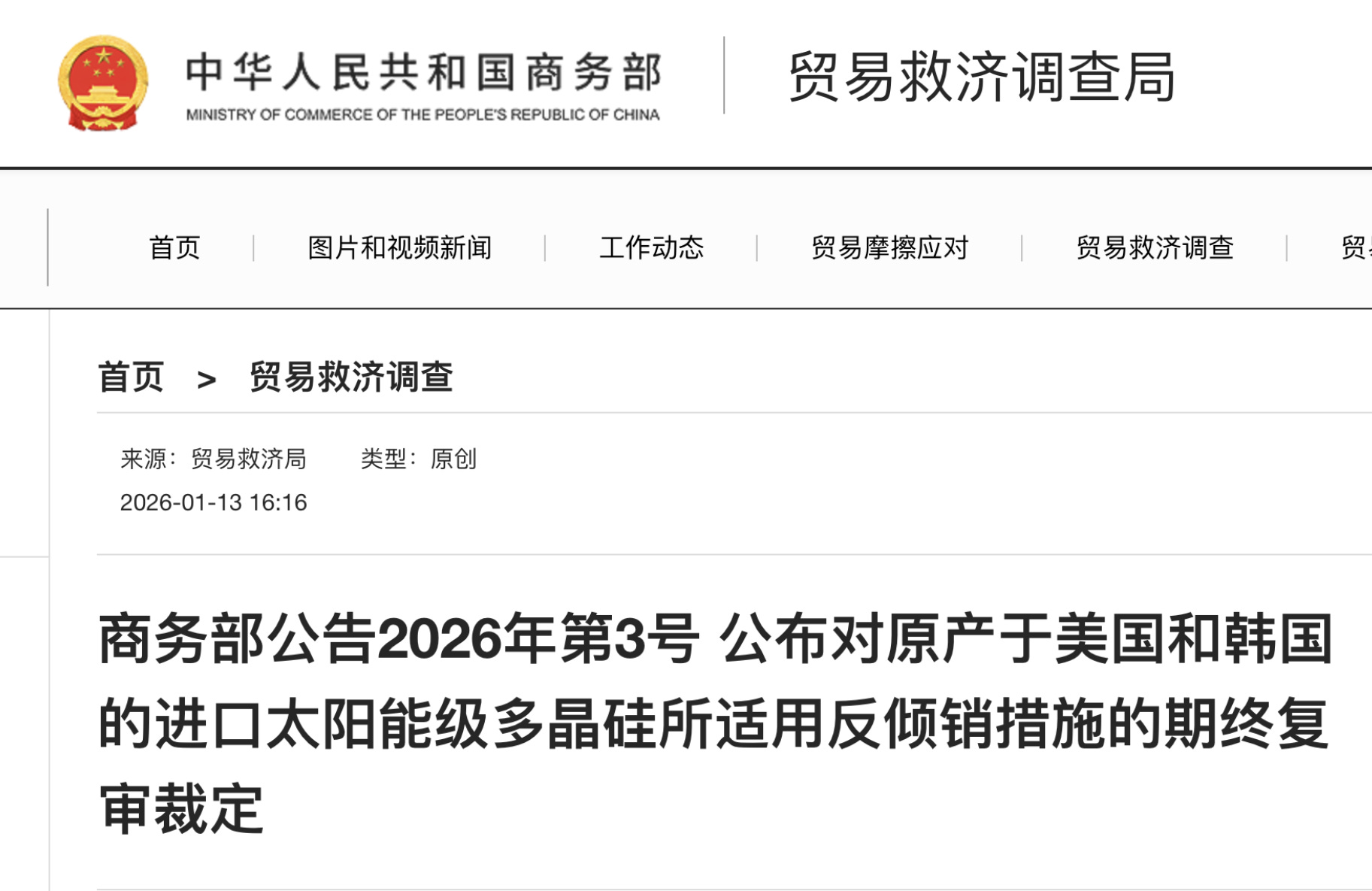
This decision follows a routine expiry review that began in January 2025, after a request from the Chinese polysilicon industry. MOFCOM concluded that if the duties were lifted, both dumping and harm to China’s domestic producers would likely continue.
The anti-dumping duties, originally imposed in 2014, target specific U.S. and Korean producers. For example, U.S. companies like REC and Hemlock face duties ranging from 53.3% to 57%, while some Korean companies such as OCI face much lower rates (as low as 4.4%), but others like Woongjin and KCC are still subject to very high rates (up to 113.8%).
The affected product—solar-grade polysilicon—is a key raw material used to make photovoltaic cells for solar panels. This ruling does not apply to electronic-grade polysilicon used in semiconductors.
Starting January 14, 2026, Chinese importers of these products must continue paying anti-dumping duties to Customs based on the import value. Those who disagree with the decision can pursue administrative review or take legal action in court.
MOFCOM Announcement No. 3 of 2026: Final Determination of the Expiry Review on Anti-Dumping Measures Applicable to Imports of Solar-Grade Polysilicon Originating in the United States and the Republic of Korea
Issuing Authority: Bureau of Trade Remedy Investigation
Document Number: MOFCOM Announcement No. 3 of 2026
Date of Issuance: January 13, 2026On January 20, 2014, the Ministry of Commerce (MOFCOM) issued Announcement No. 5 of 2014, deciding to impose anti-dumping duties on imports of solar-grade polysilicon originating in the United States and the Republic of Korea, at rates ranging from 53.3% to 57% for U.S. companies and 2.4% to 48.7% for Korean companies, for a period of five years. On November 21, 2017, MOFCOM issued Announcement No. 78 of 2017, adjusting the anti-dumping duty rates on Korean imports to a new range of 4.4% to 113.8%. On January 19, 2020, through Announcement No. 1 of 2020, MOFCOM decided to continue imposing duties as per the rates in the 2014 and 2017 announcements for another five years from January 20, 2020. On May 29, 2020, through Announcement No. 21 of 2020, MOFCOM approved the succession of Hanwha Solutions Corporation to Hanwha Chemical Corporation’s applicable rates and obligations under the anti-dumping measures.
On January 10, 2025, following an application from the Chinese solar-grade polysilicon industry, MOFCOM initiated an expiry review investigation (Announcement No. 7 of 2025) on the continued imposition of anti-dumping measures on solar-grade polysilicon originating in the U.S. and Korea, effective from January 14, 2025.
MOFCOM has since conducted an investigation to determine whether, should the anti-dumping measures be terminated, dumping and material injury to China’s domestic industry would likely continue or recur. Based on the investigation and pursuant to Article 48 of the Anti-Dumping Regulations of the People’s Republic of China, the following ruling is made:
I. Review Determination
MOFCOM concludes that if the current anti-dumping measures are terminated, dumping of solar-grade polysilicon from the U.S. and Korea is likely to continue or recur, as is the injury to the domestic industry.
II. Anti-Dumping Measures
In accordance with Article 50 of the Anti-Dumping Regulations, MOFCOM has recommended that the Tariff Commission of the State Council continue to impose anti-dumping duties. The Tariff Commission has decided to continue the duties from January 14, 2026, for a further five-year period.
Product Under Investigation
Name (Chinese): 太阳能级多晶硅
Name (English): Solar-Grade PolysiliconDescription: Polysilicon products in rod, lump, or granular form, produced using trichlorosilane as raw material through modified Siemens or silane-based processes. These are used in the production of crystalline silicon photovoltaic cells.
Technical parameters include:
Base phosphorus resistivity < 300 Ω·cm
Base boron resistivity < 2600 Ω·cm
Carbon concentration > 1.0×10¹⁶ (at/cm³)
N-type minority carrier lifetime < 500 μs
Donor impurity concentration > 0.3×10⁻⁹
Acceptor impurity concentration > 0.083×10⁻⁹
Main use: Production of monocrystalline silicon rods and multicrystalline silicon ingots for photovoltaic cells.
Tariff code: 28046190 (under the Customs Import and Export Tariff of the PRC)
Note: Polysilicon used in the production of semiconductors (e.g. integrated circuits, discrete devices) is excluded from this scope.Anti-Dumping Duty Rates
U.S. Companies:
REC Solar Grade Silicon LLC – 57%
REC Advanced Silicon Materials LLC – 57%
Hemlock Semiconductor Corporation – 53.3%
MEMC Pasadena, Inc. – 53.6%
AE Polysilicon Corporation – 57%
All other U.S. companies – 57%
Korean Companies:
OCI Company Ltd. – 4.4%
Hankook Silicon Co., Ltd. – 9.5%
Hanwha Solutions Corporation – 8.9%
SMP Ltd. – 88.7%
Woongjin Polysilicon Co., Ltd. – 113.8%
KCC Corp. & Korean Advanced Materials Corp. – 113.8%
Innovation Silicon Co., Ltd. – 113.8%
All other Korean companies – 88.7%
III. Collection Method
From January 14, 2026, importers of solar-grade polysilicon originating in the U.S. or Korea shall pay the anti-dumping duties to Chinese Customs. The duties are calculated ad valorem, based on the customs-assessed import value:
Duty = Import Value × Applicable Duty Rate
Value-added tax at the border will be assessed on the total of import value + tariffs + anti-dumping duties.IV. Administrative Review and Litigation
According to Article 53 of the Anti-Dumping Regulations, parties not satisfied with this ruling may apply for administrative review or file a lawsuit with the people’s court in accordance with the law.
V. Effective Date
This announcement shall take effect from January 14, 2026.
Attachment: MOFCOM Final Determination on the Expiry Review of Anti-Dumping Measures for Solar-Grade Polysilicon Originating in the United States and Korea (PDF)
Issued by: Ministry of Commerce of the People’s Republic of China
Date: January 13, 2026
Last night, Trump suddenly posted that any country doing business with Iran will face a 25% tariff on all trade with the U.S. “This order is final and non-negotiable,” he wrote.
This move reflects what’s being called “secondary tariffs” — a new concept borrowed from the logic of secondary sanctions. Traditionally, the U.S. used secondary financial sanctions to punish third parties doing business with sanctioned countries, like cutting off their access to the U.S. financial system. Now, Trump is extending that idea to tariffs: if you trade with countries like Iran, Venezuela, or Russia, the U.S. will hit you with steep tariffs, even if you’re not the primary target.
This isn’t just theory — in March 2025, Trump announced a 25% tariff on any country buying Venezuelan oil, calling Venezuela “hostile” to the U.S. He signed an executive order letting the Secretary of State enforce that tariff at their discretion. This was the first time “secondary tariffs” were actually implemented, mainly aimed at China and other countries still importing Venezuelan oil.
Then, Trump threatened similar tariffs over Iran. On March 30, 2025, he said if Tehran doesn’t sign a new nuclear deal, the U.S. would consider “unprecedented bombing” and impose secondary tariffs on Iranian oil.
He later said the same about Russia: if the war in Ukraine didn’t end, countries buying Russian oil could face tariffs of 25–50%. By July, he upped that to as high as 100%, and some in Congress even proposed letting the President go up to 500%.
Most of the world sees this policy as legally shaky and damaging to global trade rules. Under WTO agreements, countries aren’t supposed to raise tariffs beyond agreed limits or discriminate between trading partners. Trump’s tariffs — especially the proposed 100% or even 500% rates — clearly break those rules, and it’s questionable whether “national security” can justify them under WTO exceptions.
India, a major buyer of Russian oil, was hit with an extra 25% tariff, raising total U.S. duties on Indian goods to 50%. That hurt trade talks and sparked backlash, including from U.S. businesses facing higher import costs. Europe also pushed back: the EU rejected Trump’s request for NATO and G7 allies to impose similar 100% tariffs on China, saying it would violate EU law and hurt their economies. Japan’s finance minister also said it was hard to justify punishing countries just for buying Russian oil.
In the end, most U.S. allies either stayed on the sidelines or offered symbolic compliance — sticking to the G7 price cap on Russian oil, but not joining the tariff campaign.
China, the main target of these secondary tariffs, issued a strong response. In September 2025, the U.S. reportedly pushed G7 and NATO to slap 50–100% tariffs on China over its oil imports from Russia. China’s Ministry of Commerce condemned the move as unilateral bullying and economic coercion, saying it threatens global supply chains and trade stability. Beijing warned it would take all necessary measures to defend its interests.
Geopolitechs, look at the fine print. This is Industrial Hygiene, not just Retaliation.
You are linking this to Trump's "Secondary Tariffs." While the timing is political, the logic is purely Industrial Dominance.
1. Starving the Competition (Solar-Grade) Why extend duties on US/Korean polysilicon? Because China dominates 90% of the global solar supply chain. By locking US producers (like Hemlock) and Korean producers (like OCI) out of the world's biggest market (China), Beijing is starving them of revenue. Without access to the Chinese "End User," these foreign competitors cannot scale. They wither and die. It ensures that the "Solar King" (China) faces no usurpers.
2. The Critical Exception (Electronic-Grade) Did you catch the exclusion?
"This ruling does not apply to electronic-grade polysilicon used in semiconductors."
This is the System B rationality test.
Solar Poly: We dominate it -> Tariff it to death.
Chip Poly: We still need it -> Let it flow. Beijing never lets "Anger" get in the way of "Supply Chain Security." They only shoot where they are bulletproof.
3. Trump's "Secondary Tariff" Trap Trump's move to tariff anyone trading with Iran/Venezuela is an attempt to globalize US Law via the Customs Border. It is the "Weaponization of Consumption." But Physics has a loophole: The Dark Fleet.
System A says: "If you buy Iranian oil, pay 25%."
System B responds: "This isn't Iranian oil. It's 'Malaysian Blend' mixed at sea."
The tariff wall is high, but the smugglers are digging tunnels.
Conclusion: MOFCOM is playing Go (Weiqi)—securing territory (Polysilicon). Trump is playing Poker—bluffing with chips he might not be able to cash (Secondary Tariffs). One controls the Factory; the other tries to control the Register.
Much more is still needed. Trump better withdraw from his Iranian adventurism. Or else.