

During this year’s World Economic Forum in Davos, there was a panel focused on China’s “AI+” Action Plan, moderated by Guan Xin from CGTN. The speakers included
Dawson Tong, Senior Executive Vice President of Tencent and CEO of Tencent Cloud & Smart Industries Group;
Yutong Zhang, Founder and President of Moonshot AI;
Professor Gong Ke, Executive Director of the Chinese Institute for New Generation AI Development Strategies at Nankai University;
Hisham Alrayes, Group CEO of GFH Financial Group.
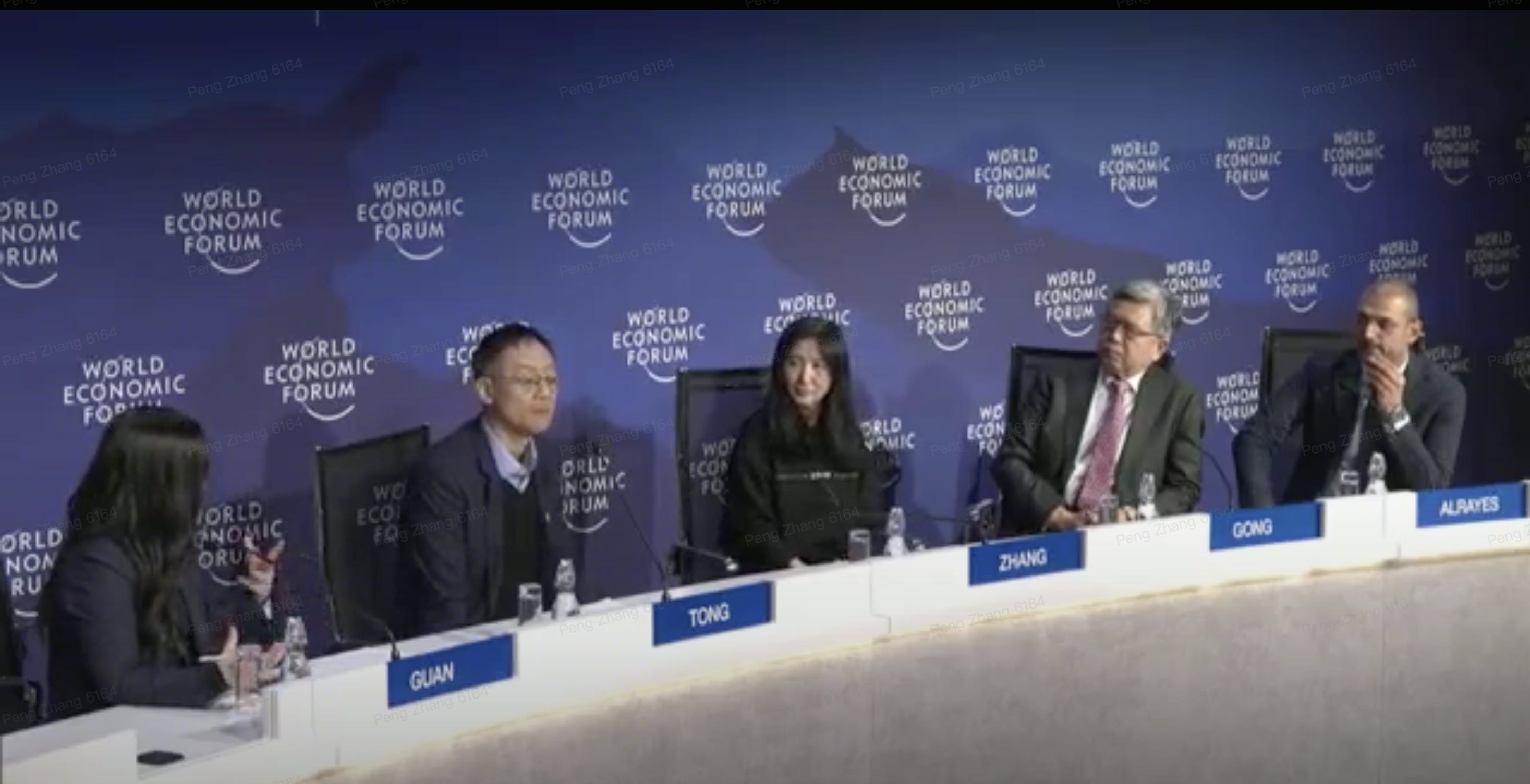
It was an interesting discussion, especially given the global spotlight of Davos and the diverse backgrounds of the participants, and it’s well worth paying attention to how China’s AI policy was framed.
Broadly speaking, the panellists agreed that China is not treating AI as a race centred on AGI, compute power, or ever-larger models, but rather as a broad productivity upgrade for the entire economy. The national “AI+” plan deliberately downplays frontier hype and instead focuses on diffusion, adoption, and real-world deployment—turning AI from a chat tool into actual products and services across manufacturing, healthcare, finance, and consumer sectors. The ambitious adoption targets for 2027 and 2030 are essentially about making AI a widely available basic capability, not something reserved for a handful of companies or industries.
From both the business and investor perspectives, there was strong consensus that China is particularly well-positioned for large-scale AI deployment. On the one hand, it has massive industrial ecosystems and a society that is generally open to new technologies, allowing AI applications to be tested, refined, and scaled quickly in areas like manufacturing, retail, and transportation. On the other hand, constraints on compute and resources have pushed Chinese AI companies to focus on efficiency from day one, rather than simply throwing more compute at the problem. Through engineering-driven approaches, open-source ecosystems, and cost optimisation, AI is being made affordable and usable at scale. Combined with investments in power generation, data centres, and initiatives like “East Data, West Computing,” China is building a relatively low-cost and sustainable foundation for long-term AI expansion.
When it comes to education and jobs, the panellists largely agreed that the real challenge of AI is not whether it replaces people, but how it reshapes skills and capabilities. Going forward, learning ability, general reasoning, and the capacity to work effectively with AI will matter far more than narrow, task-specific skills. Stepping back, China’s AI ambition is not about “winning” a symbolic tech race, but about turning AI into infrastructure—like electricity, water, or the internet—and using large-scale adoption to reshape its economic structure and production model. This, more than anything else, is what fundamentally distinguishes China’s “AI+” path from those being pursued in Europe and the United States.
Below is the full transcript of the panel:
Guan Xin
Good afternoon, ladies and gentlemen. Welcome to this issue briefing of China’s AI plus emy. My name is Guan Xin. I’m from China Global Television Network. We’re now at the pivotal moment. Artificial intelligence is rapidly transitioning from a technological frontier to a core driver of global growth. By 2030, AI is expected to contribute about $15 trillion to the global emy, and China is expected to capture about a quarter of that value in 2025. 87% of Chinese companies plan to increase AI investment and more than half reported faster deployment. And China’s national AI plus Action plan is accelerating integration into vast industries. The manufacturing, healthcare, finance, just name a few. And China’s scale, integrated policy approach and a vibrant market offered a unique model for the global AI adoption.
So to delve further into China’s AI plus development, I’m privileged to be joined here by an outstanding panel of speakers, and they come from different backgrounds from the academia, industry and frontier innovation and global finance. Please allow me to introduce them, professor. Oh, let me start with. Mr Dallson Tone, senior executive vice president of Tencent and CEO of Tencent Cloud and Smart Industries Group. Very warm welcome to Yubo Dawson. And next to him is Miss Yu Tong Zhang, founder and president of Moon Shot AI. Thank you so much for joining us. And next to him is Professor Gong Ke, Executive Director of the Chinese Institute for New Generation AI Development Strategies at Nankai University. And welcome, Professor Gong. And last but not least, Mr Hasham Aura. Yes, Group CEO of GFH Financial Group. It’s such a pleasure to have you with us. So that session is about 30 minutes long, including our discussions and a very brief Q&A session. And just a reminder, if you’d like to share your thoughts about this session on social media, please use the official hashtag am 26. And let’s dive right in. Let me start with Tishan, because I’d like to have a global investor perspective. We were now in this unprecedented fervour of AI investment, but discussions about the AI bubble, you know, the intensity of capital investments meets uncertain path as of return also grow quickly. So I know you’re investor who navigate cycles and in what areas are AI generating, you know, tangible, measurable emic value today.
Hisham Alrayes
Thank you for having me today. I think the, we had a discussion this morning in the governance session, and there was a poll and 60% of the people think it’s not a bubble. And the opportunity to.
To capture the value still there, and I think that there is substantial value and returns to be extracted out of this new market changing invention and change, and not only in AI specific, but also through the full spectrum of from power generation to data centers to chaps to tick technology, software and capital market. So the advancements of technology require heavy investments. And we come with, from the wealth management and asset management and the, and you see the developments throughout the world, whether through in China or in the States or also from our region, the requirements of government investment solo cannot drive and take it to the next level. So you’ll see a lot of the founders and companies, they raise globally and the, when their capital markets are stronger, you will see more advancements, stronger research and higher delivery and a shorter cycle for delivering return investments.
So I think the opportunity is massive, and the, we’re just at the beginning, and the ability to transform this and to. Throughout the emy to create a true value in short period of time, as the, whomever does that will be the winner. And I think China AI plus as a true serious desire to deliver on that to win the race.
Guan Xin
You’re spot around China’s and AI plus action plan is what we’re going to zoom in now. Professor Guang, give us an academic, you know, perspective on China’s AI plus action plan and how it shows about the potential of AI in creating growth drivers across China’s emy.
Gong Ke
Yeah, actually the AI plus action is a national initiative officially announced last year in Au, Au in August. So. In this document, if you read the document, you cannot find any words talking about AGI. You cannot find any words talking about the chips. It does not mean the Chinese government don’t understand the importance of AGI, don’t understand the importance of chips, but that means the Chinese government lay more emphasis on the diffusion, on the adoption, on the penetration of AI. And to make AI, really make values in production and in the daily life.
So the main direction is to move AI from chat to product to services. So there are two, the goal was set in two steps. First, by 2027 Next year, the popularize the diffusion rate of the AI agent and the terminal. Intelligent terminal will exceed 70% and by 2030, over 90%. So that’s the goal of the diffusion of in China. This is the goal of AI plus.
Guan Xin
And let me turn to Yutong, leading an AI company at the, you know, frontier. What, how do you think about China’s approach, like focusing on the diffusion and does not mention AGI? And if we talk about the diffusion of AI, what are the biggest, you know, blockers or enablers of AI adoption in emy?
Yutong Zhang
Yeah, I think China is a very unique market. I think China market is huge in many perspectives. You know, it has a huge manufacturing industry, huge retail industry. I think many industry give us the environment to build a real scalable system in production. You know, there will be like many datas, many use cases that people can try, you know, use AI to couple with. So I think this is one of the advantage in China market. And I think secondly is the openness to new technology because we have seen it continuously, the pattern in several of the technology wave. You know, in in EV in solar, in smartphone, in autonomous driving, I’m personally surprised. 85% of the Chinese people think autonomous most driving is safe and also can improve their lifestyle and productivities. So that’s why I think China has like thousands of robot taxi already run in like the 10th of the cities.So I think this like openness to technology really ready to embrace new technology, it’s very unique for China. And also, I think lastly, I think AI actually helps a lot. On really deliver a hyper productivity tool for the individuals. Even today, you know, like, oh, we’re still a startup company. We do a lot of hirings, the resume that we receive, our personal website already, nobody actually give us the PDF anymore. They use the web coding product. You know, people with zero knowledge of code before, but they can, you know, create this like beautiful personal website to applying for jobs. So I see this like adoption is, you know, from different layers of drivers.
Guan Xin
That’s right. And thousand Tencent is serving vast industries and UCS, the full spectrum. Just tell us how Chinese, you know, technology and industrial leaders are integrating AI and to drive tangible results.
Dowson Tong
Well, we definitely work with a lot of customers from different industries to deploy all forms of AI. When people talk about AI, I think we might tend to think of one big supersystem and give it a term AGI. But in fact, in reality, there are many different types of models that serve different purposes. And more specifically, when you look at the different industries in different enterprises, they are trying to use AI in every single function within their operation.
Dowson Tong
For example, at ¢10, not only many of our programmers are using coding tools extensively to. Turnout features much faster than before. We’re also seeing product managers, designers, accountants, basically, you know, from different roles are using these modern tools to automate their work, building tools that otherwise won’t be possible to enhance individual’s productivity.
Some of the customers that we work with in the retail sector, for example, they, some of them use Gen photo technology, Gen 3 d model technology to speed up their product design cycle.
We help a lot of customers to use AI to get better ROI on their marketing dollars that they spend by better targeting, more personalized service that leads to better conversion. And not to mention, there are a lot of AI applications in healthcare. We help some of the pharmaceutical companies with drug discovery. So I think we’re seeing a lot of the energy, positive energy to you endorse AI in the current environment.
One thing I want to highlight though is that it’s pretty common in China that people are looking for good ROI. They want to lower the cost of using AI. And for us, we, as part of our cloud technology, we always look for optimization for. The cost using AI so that it can be distributed, it can be diffused to a much wider community, leaving nobody behind.
Guan Xin
And Hisham, let me bring back the, your global investment perspective. Now you have heard about China’s national strategy and also these business dynamics. What do you think about China’s, you know, AI plus development? And do you find it maybe how do you compare it into global AI development?
Hisham Alrayes
Yeah, so my view is 1 to it starts from the top. Yeah, so it’s the discipline and direction, whether it’s a country or a region, or is it it’s a or even if it’s a company.
So in our company, I went and we assigned 10% of the yearly objectives of all chiefs that they have to see how to adapt the AI. And not to adapt it AI as an interface, but how to transform that an actual efficiency.
Hisham Alrayes
Now if you take that example and move it to a country, you’ll see the compounded benefit onto the emy. Then you look at the open structure of the China AI philosophy, let’s call it. Then you have the non open structure. Okay, and that signal that the benefit they want to see it. To trickle down into the emy, into the companies. So it’s a more of affordable. So it’s not the benefit of that company, of that product that a turn of that individual. It’s not an individual, it’s an emy. And this is very interesting. And they have applied that across the emy.
Now in our region, you will see also very leading models in UAE, for example, and how they wants to make the AI as a part of mandatory learning process and schools also in Bahrain. Yeah, so different countries that are taking different commitment levels. And I think soon or now we are seeing AI becoming as a part of the lifestyle. So it’s a more of the lifestyle and how you utilize that, but it’s very interesting to see the.
What’s the indie game? I think China is looking to create value throughout the emy. Very clear with very specific objectives cross the emy, not just as a benefit of those companies and the, and this is the difference in the philosophy. I think.
Guan Xin
That’s right. Your position is very right on the point because China is really integrating AI into various aspects of the emy and talking about the emy, it ultimately is about. People’s emy and how we work. Professor Gong, in your opinion, how is China’s AI push influencing workforce strategies from talent development to organizational design.
Gong Ke
Actually, back to the national initiative, AI plus, there are six emphasis, six focuses are identified. First is to use AI to empower site. Tech, R&D. And second is to enhance the capability of our production industry, including agriculture, and to increase the quality of our production to reduce the carbon emission and so on, so forth. And the third is to increase the domestic consumption. That is very important choice to make this because that’s on the other side in China to try to decrease the trade suppliers worldwide. So how we increase the domestic consumption?
Early this morning, I heard from JD.com, that’s the goose named with smart, has doubled the last year. And the fourth one is to increase the welfare of the citizen, including education and healthcare.
Talking about education now in China, we have very ambitious program to embed AI basic literacy from the primary school and also in university. The AI agents widely use is, for example, in my university, there’s about thousand different kinds of agents is used by professors and students to help their studies, their learnings. So that’s the program.
I think it is very important for the young people to have the capability use AI. We don’t know the future job. But we know definitely the future job needs the capability of using AI.
Guan Xin
And I think China is definitely a good, I think setting out these priorities. And yutong, you’re in the industry and a lot of people are comparing the environment of AI development between China and other, you know, major countries when it comes to, you know, like infrastructure or energy or other, you know, key elements to drive the future AI development. In your opinion, what support are proving the most critical in, you know, scaling the successful AI use?
Yutong Zhang
I think there are definitely differences that what we’re trying to do. I think we have build a comparable set of the art performance model, but by only using 1% of the resource of the, you know, comparable frontier labs. So I think the difference is from day one that we know that we don’t have the luxury to just scale up the compute.
So I think our development approach is more about, we do a lot of fundamental research and innovations. So the founder of the company is actually from academia. You know, all the technology of AI actually all from academia, very open community. And then we actually focus a lot on doing the fundamental research to trying to increase the efficiency. So I would say the efficiency of development, it’s very important and not many company can do that. I think. Oh, a lot of the research are just stay at the lab, but we spend a lot of time to making all the research work in a production system with all the engineering man mindset to make it work at scale. You know, like a moon, the optimizer that we’re using, we’re the first one to make it workable in a large language model training. And also we have the linear attention Kimi, we call it Kimi Linear, which is faster than the full attention system. So I think we did a lot of things to make sure that the efficiency is really high.
And this is what has been defined when you’re developing the AI systems from China. So I think the, from the support perspective, definitely infrastructure is very important. I think China always have a infrastructure first thinking whenever doing everything, you know, they build highway and they build electricity plans and also the huge data centers in multiple cities. So I think that really makes the supply very cheap. So that will not, you know, unblock the innovations from Frontier Technology. So I think that would be very helpful. And, but the company also needs to be extremely efficient.
Guan Xin
So efficiency is a keyboard here. Dawson, would you agree? Would you like to list some of the factors, you know, the most important to scale on AI development in China and how is China doing that?
Dowson Tong
Well, efficiency is definitely a very important drive in the China market. But in addition to that, I think one thing that’s the of notice that. The China AI ecosystems or technology ecosystems in general is very vibrant. There are a lot of players in the model side compared to some other markets. I think the number of model companies, we have a lot more in China.A lot of them are open source. And two of the biggest IPO in the Hong Kong Stock Exchange. This year, we’re at companies with very different focus. One focus on the consumer side, overseas market, the other open source, but more on the enterprise side. And including moonshot, it’s also a partner of ours, even though we also have our own model called high. But the interesting thing is that there are so many players in the ecosystem, with open source being a very strong driver that helps lower the cost of doing the inference using AI. We’re seeing the cost of using AI in China, at least for the past 18 months, continue to come down. And for Tencent, we understand that customers want choices. You know, there are many different use cases for a company, and they might want to use different models of different sizes for different purposes. So our focus as part of the cloud strategy is to provide tools, products that are model agnostic, support different types of models. I think that gives the. The power of choosing the right model for themselves back to the hands of the customers, right?
Guan Xin
And no one has talked about energy. And I like to ask Professor Gong about this because energy use is really one of the taught, the crucial, you know, elements in AI development in the future. Do you think China is well positioned to provide energy much needed?
Gong Ke
Yes, actually, there’s another very important initiative relevant to the AI development. If we called the energy infrastructure built mainly with green energy in the western part of China, because where reach wind power and solar power there and use the wideband transmission network to help the companies in the western coast to use that computer power. So we called it Dongshu Xishun. That’s the data is a west and the computer power. Yeah, computer power in the west, but data in the east. So that’s a big issue. That means by the end of 2030, a large amount power used by AI would. Would be green renewable.
Guan Xin
Power. Fantastic news. And we may have a few extra minutes to, and open this to the floor. And okay, please briefly introduce yourself and ask questions.
Audience
Thank you so much for sharing insight. I am Sayaka Tanaka and I’m from Japan and I am the founder of waffle, which is mission is to cross agenda gap in tech industry and also engage in policy recommendation. And I have a question. To Gong’s Gong Sun.
And I like to understand the level of the content of AI education in Chinese elementary and junior high and high schools. Is creative education, such as developing product using AI, not just AI literature, including in compulsory education. And also how are the teachers trained or supported so that they can teach AI effectively?
Gong Ke
There’s a nationwide program for teaching the teachers, training the trainers to use a. I, and also, we carefully adopted the United Nations framework for the competence of teachers and students in AI. So if you could see, China is the first country to have the white paper on the AI application in education. So if you have chance to read that white paper, you can get more information.
Dowson Tong
Can I add to that? I think the new generation learns AI. The only from schools and the traditional education institutes by, you know, having very free tools. In our case, like what we call Yuan Bao, many young generations can go to these ChatGPT like app to ask questions to meet their curiosity needs. I think encouraging the new generation to be curious and use these really accessible AI tools would be the best way to develop the habits of using AI as part of the learning tool.
Audience
Thank you for an interesting session. My name is said Sakri. I’m an emist from Amman. And I am curious, you know, anybody can answer actually about the impact or the negative impact of using AI. On education especially and on labor market, you know, adopting technologies has always been also part of adaptation has had negative impact in, on education, on emic activities, especially the labor market. I don’t know if you have assessed or looked into that and what was your conclusion. And now you have already adopted and I’m very happy to see that you have a white paper for use of a of AI in education system, but maybe you have already an experience and have seen some of the negative impact of adopting AI and the impact on people’s education abilities and so on. And also on the traditional jobs and the markets that usually we, everybody can do. And now it is being done by AI. Thank you very much.
Gong Ke
Let me shortly answer your question about education because there’s a negative site. So the challenge is how to help students to use AI to empower their deep thinking. Not satisfied, but the instant answer. That’s a very big challenge. And also talking about the workforce, the employment, by far, that’s the early phase of AI adopting the improvement is increasing last year, the year before last year. And in the Chinese job match, this deficits 5 million workers. The required to have the AI capability, but it along. With a deeper adaptation, adoption of AI, the some job will be replaced. So that’s a nationwide plan to upscaling the workers to be able to use AI and to find new tasks which is empowered by AI. So I stop here. Thank you.
Yutong Zhang
Yeah, I think I just want to add some echo to Professor Gong’s comments. I think it’s not not s not necessarily negative effect, but I do see change in terms of, you know, the people that, you know, we want to work with, like in a new type of, you know, AI native organizations. So we really emphasize on having the people have general intelligence capabilities rather than specializations. I think that’s like a trend because AI can provide some on demand expertise in the domain. And also s, I think for the organizations, the historical function based organization structure will also be changed.
So I think secondly is I feel like human creating new knowledge at a faster speed than before. At least for the, you know, past two years, I sleep very little. And, you know, we have a lot of progress. And we, oh, I think every day is like we feeling that the learning ability is very important than the past experience because it past experience and past knowledge may get expired sooner than before. So I think that’s that is also very important. So actually, I think the education system, if you know, they can adapt to, you know, develop more general thinking and general knowledge and also to refer. And also like a good, really good like learning ability, really good AI proficiencies. We still think, you know, like we’re still find difficulties in hiring, you know, rather than the opposite.
Dowson Tong
I think we need to learn how to ask the right questions. That’s a very important yes.
Guan Xin
Can you do it very briefly. The last year that was not worthy American supremacy, EDI was celebrated. Few weeks later, there was the DeepSeek moment. What’s the likelihood we have something similar this year? How far are we from another DeepSeek moment?
Gong Ke
I don’t know.
Yutong Zhang
We will launch a new model very soon.
Gong Ke
That model is quite good, Kimi. This is a good model.
Guan Xin
Okay, let’s wait and see. And you know, there are always new excitement on a horizon. And let’s, you know, we have this open minded. You know, participants in this industry, and let’s hope for more progress in the sector. And thank you so much for joining us. And if you continue with this, your thoughts about the conversation, you can use the hashtag am 26 on social media. The session is concluded. Thank you so much.
Dowson Tong
Thank you.
Vertical Ascension vs. Horizontal Diffusion: The Two Bets
Geopolitechs, this transcript is a goldmine. It doesn't just show a difference in policy; it reveals that System B (China) and System C (Silicon Valley) are diverging into two distinct evolutionary species.
1. Verticality vs. Horizontality
System C (Silicon Valley) is betting on Vertical Ascension. They are obsessed with AGI not because it is a "theology," but because it is their only way out. They are trying to create a "Digital God" (Super-Intelligence) to break the ceiling of current physics (e.g., solving fusion, material science). It is a high-stakes attempt to rewrite the rules of reality.
System B (China) is betting on Horizontal Diffusion. As the panelists (Tencent, Prof. Gong) made clear, they are not looking for a god; they are looking for a better utility. They want to pipe AI like electricity into every factory floor to upgrade their R.I.C.E. System (Resource, Infrastructure, Chain, Efficiency).
2. The High Variance Bet Yutong Zhang’s comment about "focusing on efficiency from day one due to constraints" is critical.
System B is evolving "Lean AI"—robust, efficient, and capable of surviving in a resource-constrained physical world.
System C is evolving "Maximalist AI"—burning entire cities' worth of power to achieve a Singularity. It looks like waste, but it is actually a Gamble on a Mutation. System C is betting that "Brute Force" will eventually crack the code of the universe.
Verdict: This is the ultimate showdown of 2026:
If AI remains just a tool, System B wins (The Shield), because the R.I.C.E. system will absorb it to become hyper-efficient.
If AI achieves a species-level mutation (AGI), System C wins (The Spear), because they will render the old physical advantages obsolete.
Great catch on this panel. Essential reading.
Ref : The American Trilogy Part I: The Silicon Constitution (C.O.D.E.)
https://chinarbitrageur.substack.com/p/the-american-trilogy-part-i-the-silicon?r=71ctq6